


If you haven’t changed your price in over a year, it’s probably time to raise your freelance rates. Your skills have grown, your tools cost more, and everyday prices have kept climbing. Your rate is the only thing standing still.
Most freelancers know this. They just don’t do it. The fear is simple: “What if my best client leaves?”
That fear is real, but it’s usually bigger than the risk. Handled well, a price increase rarely costs you good clients. This guide shows you how to pick a number, tell people, and deal with the replies, one step at a time.
Five Signs You’re Charging Too Little
Not sure you’re ready to raise your freelance rates? If two or more of these sound familiar, you are.
- You’re fully booked but still feel short on money every month.
- New clients say yes to your quote instantly, without any questions.
- Your rate hasn’t moved in 12 months or more.
- You’ve added new skills, tools or results since you last set it.
- You quietly resent a project because of what it pays.
That second sign surprises people. If nobody ever pushes back, your price is likely below what the market will pay.
There’s an outside reason too. Living costs keep rising. The U.S. Bureau of Labor Statistics Consumer Price Index showed prices up 3.7% over the 12 months to September 2026. A rate that stays flat is a pay cut in disguise.
Step 1: Work Out Your Real Minimum
Before you raise your freelance rates, know your floor. That’s the lowest rate that still covers your life, your business costs and your taxes.
Upwork’s guide on how to set your freelance rate suggests working backward: start with your income goal, add business expenses, then divide by the hours you can realistically bill.
Here’s a quick example. Say you want $36,000 a year, spend $4,000 on tools and software, and set aside $8,000 for tax. That’s $48,000. If you bill 1,000 hours a year, your floor is $48 an hour.
Anything below that number, you’re working at a loss. Our freelance business finance tips walk through this math in more detail.
Step 2: Decide How Much to Raise Your Freelance Rates
There’s no magic percentage, but most freelancers land somewhere between 10% and 25% for existing clients. New clients can start at your full new rate straight away.
| Situation | Typical increase |
| Yearly update, same work | 5–10% |
| New skills or better results to show | 10–20% |
| Rate well below market | 20–30%, or phase it in |
| Moving to a new niche or premium service | Set a new price for new clients only |
Check what others charge for similar work before you settle. Our comparison of pay scales across freelancing platforms is a good starting point.
When you raise your freelance rates, round to a clean number. $55 reads as more confident than $53.75.
Step 3: Start With New Clients
The lowest-risk way to raise your freelance rates is to test them on people who’ve never paid your old price.
Quote every new lead at the new rate for a month. Watch what happens. If most still say yes, you’ve got your answer, and you’ll feel far more confident talking to existing clients.
If several walk away, don’t panic. Look at who left. Price shoppers leaving is often a good sign.
Step 4: Give Existing Clients Plenty of Notice
Nobody likes surprises on an invoice. Upwork’s advice on negotiating freelance rates is to give clients plenty of warning and time increases well, for example after a project they valued or at the start of a new year.
Thirty to sixty days’ notice works for most people. It gives clients time to adjust their budget and shows you respect them. When you raise your freelance rates with this much warning, most clients simply update their plans.
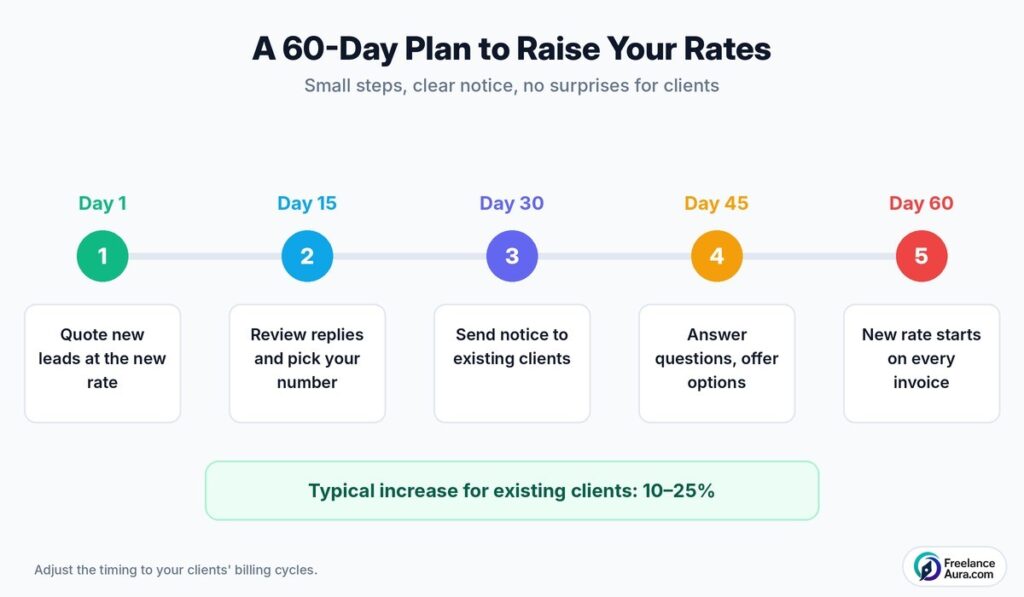
Alt text: Timeline showing how to raise your freelance rates in five steps over 60 days
The timeline above shows a simple 60-day plan: test with new leads, decide the number, send the notice, follow up, then switch.
Step 5: Use a Short, Confident Message
You don’t need to apologize or write an essay. Keep it short, friendly and clear. Here’s an example you can adapt the next time you raise your freelance rates:
“Hi Sara, I’ve really enjoyed working on your newsletters this year. From 1 January, my rate will be $55 per hour, up from $45. This reflects the extra strategy and reporting I now include. Anything already booked before then stays at the current rate. Happy to talk it through if you have questions.”
Notice what it does. It thanks them, gives the new price and the date, explains briefly, and protects work already agreed. There’s no begging and no long justification.
Clear, calm communication like this is one of the soft skills for freelancers that makes money conversations much easier.
Step 6: Handle Pushback Without Folding
Some clients will reply with a question or a worry when you raise your freelance rates. That’s normal, not a crisis. Here’s how to answer the common ones.
“That’s more than our budget.”
Offer a smaller scope instead of a smaller rate. “I can keep within your budget by moving to two articles a month instead of three.” This protects your price and still keeps the client.
“Can you keep us at the old rate?”
You can offer a short grace period, such as three months at the old price. After that, the new rate applies. Be warm, but don’t reopen the decision.
“Other freelancers charge less.”
They probably do. Remind the client what they get from you: reliability, results and less management. Then let them decide. Some clients are a better fit for a cheaper option, and that’s fine.
Step 7: Put It in Writing and Follow Through
Once a client agrees, update your contract or statement of work. Our guide to clauses that protect freelancers covers what to include, including how future rate changes work.
Then actually bill the new rate on the agreed date. Many freelancers announce an increase and then quietly keep invoicing the old amount. That teaches clients your prices are negotiable.
If a project’s scope grows during the switch, handle it separately. Our post on scope change without losing money explains how.
How to Raise Your Freelance Rates on Platforms
Marketplaces add a few extra rules. On Upwork, you can change your profile rate for new work at any time, and new hourly contracts can include a planned rate increase.
According to Upwork’s help page on scheduled rate increases, clients set this up when sending an offer, it applies only to new hourly contracts, and it can’t be changed once agreed. Mention it in your proposal if you’d like it included.
Remember platform fees when you set your number. Our breakdown of freelancer platform fees shows how much each one takes from your earnings.
When You Shouldn’t Raise Your Freelance Rates Yet
Timing matters. Hold off for a little while if:
- You’ve just missed a deadline or had a rough project with that client.
- You’re brand new and still building your first reviews.
- A client is in the middle of a big launch and asked you to keep things stable.
Fix the relationship or finish the launch first, then raise the topic. Waiting a month is better than asking at the worst moment.
What If a Client Leaves?
Sometimes a client will leave when you raise your freelance rates. It stings, but look at the numbers. If you raise your price by 20% and lose one client out of five, you’re usually earning about the same while working fewer hours.
Those freed-up hours can go to a better-paying client, marketing, or simply rest. Many freelancers say their work got better after they stopped serving the clients who paid least.
And if a former client comes back later at the new rate, which happens more often than you’d think, welcome them warmly.
How Often Should You Raise Your Freelance Rates?
Once a year is a good habit for most people. Pick a fixed month, such as January or the anniversary of when you started, and review your numbers then.
A yearly review is the easiest way to raise your freelance rates without drama, because clients start to expect it. Small, steady steps feel normal. A sudden 40% jump after three silent years feels like a shock.
You can also raise prices between reviews when something big changes, like a new certification, a strong case study or a waiting list of new leads.
A Quick Checklist Before You Send Anything
- You know your floor rate and your new number.
- You’ve tested the new rate on at least a few new leads.
- Your message is short, friendly and includes a clear date.
- You’ve decided what you’ll offer if someone pushes back.
- Your contract or invoice template is ready for the new price.
Ticked them all? Then send it. You’ll probably wonder why you waited so long.
Start This Week
You don’t need permission to raise your freelance rates. You need a clear number, a short message and the confidence to stick to it.
Pick your new rate today, quote it to the next lead who contacts you, and plan your notice for existing clients. Small, regular increases are much easier than one big jump every few years.
If late payments are also eating into your income, read our guide on handling late-paying clients. For more money guides, browse our Freelance Business & Finance category.
