

Ask any freelancer how they feel about the word “invoice” and you’ll usually get a small sigh before the answer.
Sending it is easy. Waiting for it to get paid is where the stress lives.
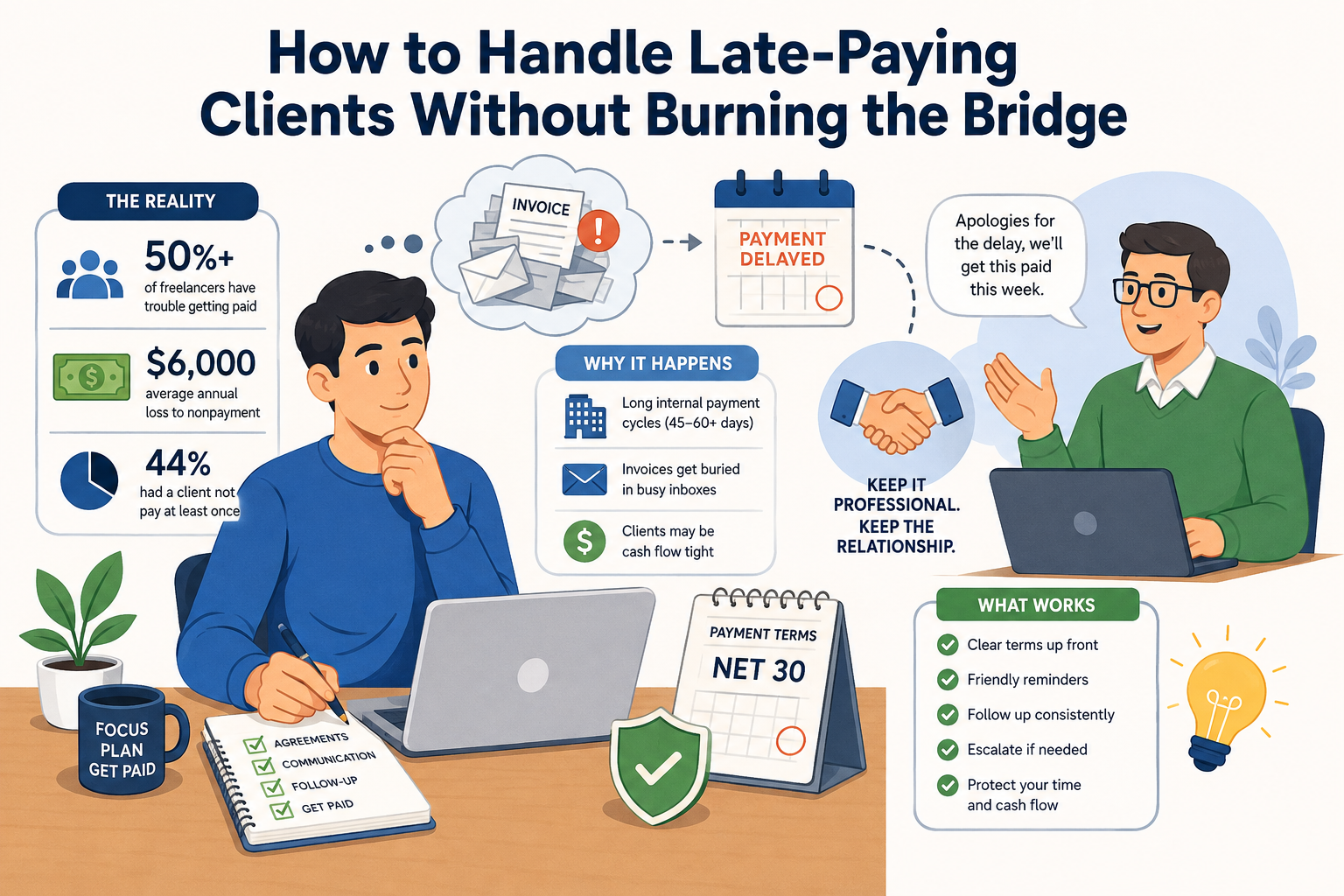
This isn’t a rare inconvenience. Freelancers Union has reported that over half of independent workers have trouble getting a client to pay them at all, and that the average unpaid freelancer loses around $6,000 a year to nonpayment — close to 13% of total income. A Fiverr survey found 44% of freelancers had a client simply never pay them, at least once. In the UK, IPSE’s Freelancer Confidence Index found 32% of freelancers had a payment delayed in the past 12 months, and Bill.com found that 45% of gig workers say clients don’t pay on time, period.
However you slice the numbers, late payment isn’t the exception in freelance work. It’s closer to the norm.
That’s what makes this such a delicate skill. You can’t treat every late invoice like fraud, because most of the time it isn’t — a finance department is backed up, an invoice got buried, a client is genuinely tight on cash this month. But “I’m sure it’s fine” can’t be your entire payment strategy either, because eventually it won’t be.
The goal is a system that gets a freelancer paid reliably without turning every client relationship into a standoff.
Why This Happens So Often
A lot of freelancers assume late payment is personal — that the client doesn’t respect their time. Sometimes that’s true. More often, it’s structural.
Larger companies often run 45- or 60-day payment cycles internally, and a solo freelancer’s invoice is just one line item competing with a hundred others for someone’s attention. Liz Steblay, founder of the Professional Independent Consultants of America, has pointed out how brutal those long corporate terms are for someone self-employed and counting on that money for rent this month.
There’s also a pattern that shows up again and again in freelancer forums: the client who pays fine for months, then quietly starts stretching the timeline.
One long-running discussion among independent contractors described a relationship that had worked smoothly for over a year, with payments landing 45 to 60 days after invoicing. Then, with no explanation, that same client’s payments started arriving at 90 days instead. Nothing in the contract had changed. The client had simply learned they could get away with it, because nobody pushed back.
That’s the pattern worth watching for:
- A one-off delay is usually just business.
- A slow creep in how late payments arrive, especially with no communication, is a client testing how much slack you’ll give them.
Start Before the Work Does
Most late-payment problems don’t start with the invoice. They start weeks earlier, in a vague conversation where nobody pinned down the details.
If a contract or proposal doesn’t spell out exactly when payment is due, what happens if it’s late, and how the client should pay, the door is wide open for “we’ll get to it eventually.”
A few things worth locking in before sending a single deliverable:
A specific due date, not a vague window. “Net 15” or “payment due within 15 days of invoice” is enforceable in a way “pay when convenient” is not. Net 30 is the most common standard in the US, but there’s nothing wrong with a freelancer asking for Net 15 or Net 7, especially without the cash cushion a bigger business has.
A deposit for new clients. Asking for 25 to 50% upfront does two things at once: it puts some money in hand regardless of what happens later, and it filters out clients who were never serious about paying in the first place. If someone balks hard at a deposit, that’s information.
A late payment clause. Spell out what happens if an invoice goes unpaid past the due date — a flat late fee, a percentage added per month, or a pause on further work until the balance clears. In the UK, the Late Payment of Commercial Debts Act gives businesses the legal right to charge interest on overdue B2B invoices at the Bank of England base rate plus 8%. Nothing that formal is required, but even a modest 1.5% monthly late fee written into a contract does more good sitting there unused than you’d expect. Most freelancers rarely have to actually charge it — its presence is often enough on its own to nudge a slow payer to move faster.
Milestone billing for bigger projects. If a project runs six weeks, don’t wait until the end to send one big invoice. Break it into deposit, midpoint, and final payments tied to deliverables. A late payment on milestone one shows up as a problem in week two, not a $4,000 surprise in week six.
None of this assumes every client is out to stiff you. It’s closer to wearing a seatbelt — you hope you never need it, but you don’t skip it because you’re feeling good about the drive.
When an Invoice Actually Goes Late
Say the due date passes and nothing lands in the account. Here’s roughly how that conversation should escalate, moving from friendly to firm without jumping straight to hostile.
1. First, a plain reminder. A day or two after the due date, send a short, neutral note — not passive-aggressive, not apologetic.
“Hi [name], just flagging that invoice #204 was due on the 12th and I don’t see it come through yet. Can you confirm when it’s scheduled to go out?”
Attach the invoice again. People genuinely lose track of these things, especially if it went to one inbox while the person who approves payments sits somewhere else entirely.
2. Second, a direct follow-up with a specific ask. If a week or two passes with no response, the tone tightens. Ask for a specific date, not a vague “soon.” This is also a fair point to mention, calmly, that continued work will need to wait until the account is current. That’s not a threat — it’s just how the arrangement works, and most reasonable clients get that.
3. Escalate the seriousness without escalating the anger. If it’s a month or more overdue and communication has gone quiet, a more formal email is appropriate — one that references the original contract terms, the amount owed, and the consequences of continued nonpayment. Keep it factual. This is the email you’d be fine with a lawyer reading later, because at this point it might come to that.
4. Decide how far you’re willing to go. For most freelancers, the realistic options past that point are a formal demand letter, small claims court (often filable without a lawyer for amounts under a certain threshold, depending on location), or writing off the loss and moving on. None of these are pleasant, which is exactly why the earlier steps matter so much. The goal is never needing to get here.
One thing worth being honest about: a lot of freelancers wait far too long to say anything, worried that asking about money will make them look unprofessional or needy. It’s the opposite. Freelancers Union’s research found 91% of respondents had experienced a late or overdue payment at some point, and most who eventually got paid only did so after following up multiple times — often three or more.
Chasing an invoice isn’t rude. Not chasing it is how freelancers end up working for free.
Reading the Client, Not Just the Calendar
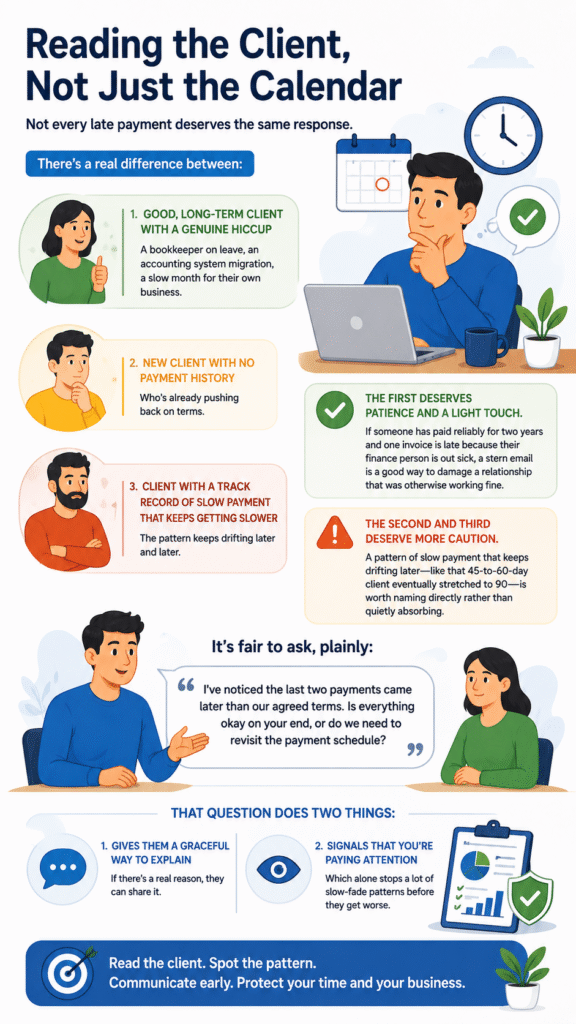
Not every late payment deserves the same response. There’s a real difference between:
- A good, long-term client with a genuine one-time hiccup (a bookkeeper on leave, an accounting system migration, a slow month for their own business)
- A new client with no payment history who’s already pushing back on terms
- A client with a track record of slow payment that keeps getting slower
The first deserves patience and a light touch. If someone has paid reliably for two years and one invoice is late because their finance person is out sick, a stern email is a good way to damage a relationship that was otherwise working fine.
The second and third deserve more caution. A pattern of slow payment that keeps drifting later — the way that 45-to-60-day client eventually stretched to 90 — is worth naming directly rather than quietly absorbing.
It’s fair to ask, plainly:
“I’ve noticed the last two payments came later than our agreed terms. Is everything okay on your end, or do we need to revisit the payment schedule?”
That question does two things. It gives the client a graceful way to explain if there’s a real reason, and it signals that you’re paying attention — which alone stops a lot of slow-fade patterns before they get worse.
Protecting the Relationship While You Protect Your Income
The instinct a lot of freelancers fight is treating a payment conversation as a confrontation. It doesn’t need to be one.
Most professional relationships can absorb a direct, calm conversation about money without lasting damage. Honestly, a client who gets defensive or angry about being asked to pay what they owe on time is telling you something useful about what it’ll be like to keep working with them.
A few things that keep these conversations from turning into a rupture:
Keep money emails separate from project emails. Mixing “here’s the design feedback” with “also you owe me $1,200” in the same message tends to make both points land worse. Give payment follow-ups their own thread.
Avoid guessing at the client’s motives in writing. Assuming bad faith in an email, even when frustrated, tends to escalate things faster than the actual delay warranted. Stick to facts: the due date, the amount, what you need from them.
Set a personal rule for how many free passes a client gets. Maybe it’s two late payments before deposits are required again, or three before new work stops until the account is settled. Deciding this in advance, before you’re annoyed, keeps you from caving every time or overreacting the one time it actually matters.
Use tools that take the awkwardness out of the follow-up. Invoicing platforms that send automated payment reminders mean the nudge comes from software rather than from you personally, which removes some of the social friction. A lot of freelancers find it easier to let a tool send the third reminder than to write it themselves for the third time.
The Bottom Line for Freelancers
Late payment isn’t a sign a freelancer is doing something wrong. Independent workers lose billions to it collectively every year, and the ones who avoid the worst of it usually aren’t the ones who got lucky with better clients — they’re the ones who set clear terms upfront, noticed patterns early, and had a slightly uncomfortable conversation before the amount owed got too large to make that conversation easy.
None of this means running a freelance business like a debt collection agency. Most clients, most of the time, pay because they value the work and want to keep working with you.
The systems above exist for the occasional client who does need a nudge, or does need boundaries — so when that happens, you’re not scrambling to figure out what to do in the moment.
You already know.
