

Freelance business finance is the skill that decides whether your freelance career grows or stalls. Great work wins clients, but smart money habits keep you in business.
Freelancing gives you freedom. You pick your clients, your hours and the work you enjoy. But that freedom comes with a hidden job: you are now running a small business.
Many talented freelancers struggle not because their work is weak, but because their money is messy. Late invoices, surprise tax bills and quiet months can undo years of effort.
This guide shares seven proven tips to fix that. You will learn how to set rates, separate accounts, plan for taxes, build a safety net and grow a steady income.
Why Freelance Business Finance Matters
When you work for a company, payroll, taxes and benefits are handled for you. As a freelancer, every one of those tasks lands on your desk.
Strong money habits give you three big wins. You get paid on time, you keep more of what you earn, and you can say no to bad clients without fear.
Weak habits do the opposite. They create stress, debt and the feeling that you are always one slow month away from trouble. Good freelance business finance turns that stress into control.
Tip 1: Treat Freelancing Like a Real Business
The first step is a change in mindset. You are not just a worker paid per project. You are a business owner with income, expenses, customers and cash flow.
Start with a simple business structure. Many freelancers begin as sole proprietors with almost no paperwork. As income grows, an LLC or registered company can offer legal protection and tax benefits.
The U.S. Small Business Administration explains the main factors to weigh when choosing a business structure. Our guide on LLC vs. sole proprietor status covers the pros and cons. Speak with a local accountant before you decide.
Next, give your business a name, a professional email address and a basic contract. These small steps build client trust and make your work far easier to manage.
Tip 2: Separate Business and Personal Money
Mixing business and personal money in one account is the most common freelance mistake. It hides your real profit and turns tax season into a headache.
Open a dedicated business bank account. Send every client payment there. Pay every business cost from it, including software, equipment, internet and training.
Then pay yourself a fixed amount each month, like a salary. This single habit is the foundation of solid freelance business finance.
If you work on marketplaces, also check our breakdown of freelancer platform fees to see the hidden costs eating into your earnings.
Tip 3: Set Rates That Cover Every Cost
Pricing sits at the heart of freelance business finance. Many new freelancers set rates by guessing or copying others. A smarter method is to work backwards from what you need.
- Decide the yearly income you want to take home.
- Add yearly business costs such as tools, subscriptions, equipment and insurance.
- Add a share for taxes, usually 20 to 30 percent depending on where you live.
- Estimate billable hours. Most freelancers bill only 50 to 70 percent of their working time.
- Divide the total by your billable hours to find your minimum hourly rate.
Once you know your minimum, think about value. Clients pay for results, not hours. Project-based or value-based pricing often earns more than an hourly rate.
Review your prices at least once a year. Raise them as your skills, portfolio and demand grow. When a project grows beyond the plan, learn how to handle scope change without losing money.
A Quick Freelance Business Finance Rate Example
Say you want to take home $50,000 a year. Your business costs are $5,000 and you set aside $15,000 for taxes. That is $70,000 in total.
If you bill 1,000 hours a year, your minimum rate is $70 per hour. Anything below that means you are losing money, even when you feel busy.
Tip 4: Invoice Fast and Get Paid on Time
Cash flow is the lifeblood of any freelance business. Without it, even the best freelance business finance plan falls apart.
- Use clear contracts. State the scope, deadlines, price and payment terms before you start.
- Ask for a deposit. A 30 to 50 percent upfront payment protects you on new or large projects.
- Invoice right away. Send the invoice the same day the work is delivered.
- Set short payment terms. Net 7 or Net 14 works better than Net 30 for small businesses.
- Make paying easy. Accept bank transfers, cards and popular online payment apps.
- Follow up politely. Send a reminder on the due date and again a few days later.
Not sure what your contract should say? Read what to include in a freelance contract. Then use our workflow template from inquiry to invoice so no invoice slips through.
Tip 5: Use the Freelance Business Finance Bucket Method
Freelance income is uneven. A big payment one month can be followed by a very quiet one. The bucket method solves this problem.
The rule is simple: split every payment the moment it lands in your account.
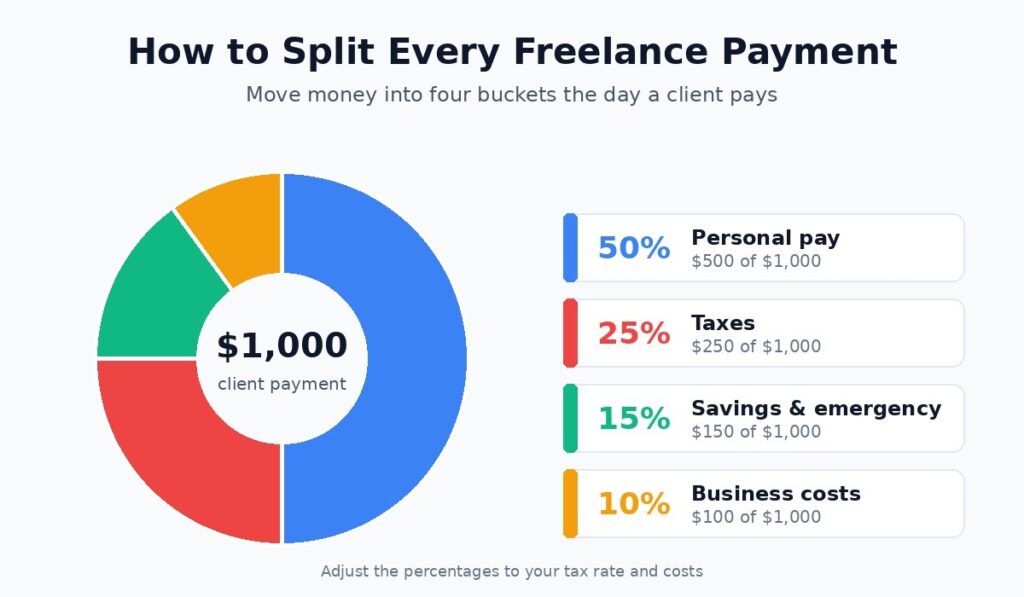
Alt text: Freelance business finance bucket method showing how to split each client payment
A common split looks like this:
| Share of each payment | Where it goes |
| 25% | Tax savings account |
| 15% | Emergency and savings fund |
| 10% | Business costs and growth |
| 50% | Your personal pay |
Adjust the numbers to match your tax rate and costs. The key is consistency. When you split every payment, tax bills and slow months never catch you off guard.
Tip 6: Plan for Taxes All Year
As a freelancer, no employer takes taxes out of your pay. That job is now yours.
Keep a separate savings account just for taxes. Move your tax share into it with every client payment, not once a year.
In the United States, self-employed people usually pay tax four times a year. The IRS page on estimated taxes explains who must pay and when. Missing these deadlines can lead to penalties.
Keep every receipt. Software, a home office, equipment, internet and work travel may be deductible. The IRS Self-Employed Individuals Tax Center is a helpful starting point for freelance business finance questions.
A good accountant often saves you more than they cost, especially in your first year.
Tip 7: Build an Emergency Fund and Plan Ahead
Clients leave, projects get cancelled and health problems happen. An emergency fund keeps your business alive through these moments.
Aim to save three to six months of personal and business expenses. Build it slowly from your savings bucket. Keep it in an easy-to-reach account, not in risky investments.
With this cushion, you can turn down low-paying work and wait for better clients. That freedom is one of the best rewards of good freelance business finance.
Do Not Forget Retirement
Freelancers do not get company pensions, so retirement planning is up to you. Long-term saving is a part of freelance business finance that many people skip. Our guide to retirement plans for freelancers explains your options without a 401(k).
Try the compound interest calculator from Investor.gov to see how $200 a month could grow over 20 or 30 years. The results often surprise people.
Track Your Freelance Business Finance Numbers Every Month
You cannot improve what you do not measure. Once a month, block one hour to review your numbers.
- Total income and total expenses
- Profit after costs and taxes
- Unpaid invoices and how long they have waited
- Income from each client
Watch out if one client brings in more than 40 to 50 percent of your income. Losing them could hurt badly, so keep marketing and adding new clients.
A simple spreadsheet works at first. As you grow, accounting software can link to your bank and track everything automatically.
Simple Tools That Save You Hours
You do not need expensive software to stay organized. A few simple tools can handle most of the work for you.
- Invoicing apps create branded invoices, send automatic reminders and accept online payments.
- Accounting software links to your bank, sorts expenses and prepares reports for tax time.
- Receipt scanner apps let you snap a photo of every receipt so nothing gets lost.
- A shared calendar helps you track tax deadlines, invoice due dates and monthly review days.
Choose tools that fit your budget and work style. Start with free versions, then upgrade only when your workload grows. The best tool is the one you will actually use every week to keep your freelance business finance on track.
Common Freelance Business Finance Mistakes to Avoid
- Underpricing your work to win clients, then struggling to raise rates later.
- Spending big payments right away instead of splitting them into buckets.
- Ignoring taxes until the deadline arrives.
- Working without a contract or a deposit.
- Relying on one or two clients for most of your income.
Each of these mistakes is easy to fix once you spot it. Pick one and solve it this month.
Final Thoughts
Freelance success is not only about great work. It is about managing money with the same care you give your clients.
Separate your accounts, price with purpose, invoice quickly, save for taxes and build a safety net. These seven proven habits turn freelancing from a risky side hustle into a strong, lasting business.
Mastering freelance business finance does not happen overnight. Start with one change this week, such as opening a business bank account, and build from there. When you are ready, explore ways to diversify your income beyond client work.
For more guides like this, explore our full Freelance Business & Finance category.
