

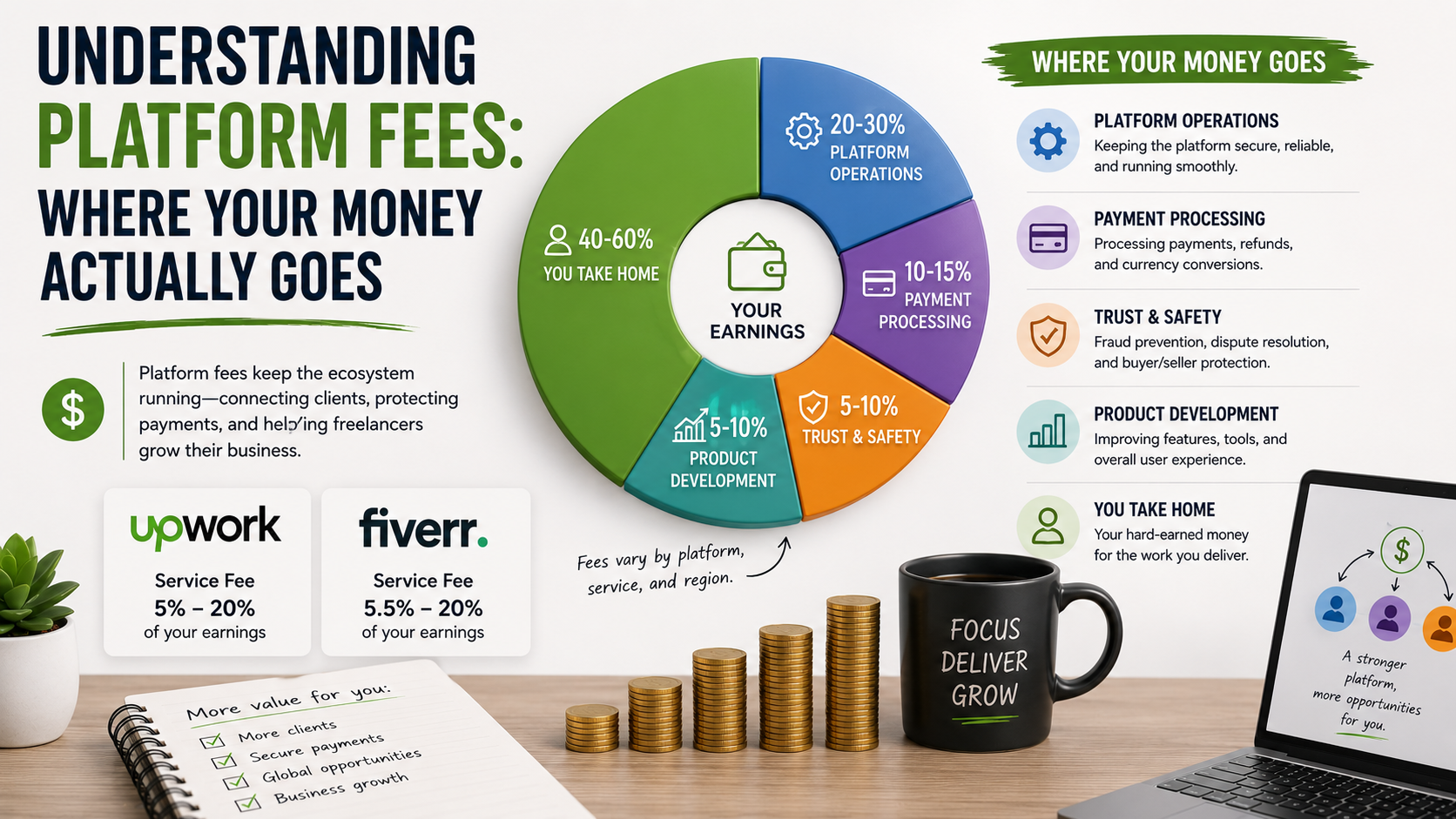
Freelancer earnings look a lot bigger on the invoice than they do once they actually land in your bank account, and platform fees are usually the reason why. Most people who work through Upwork, Fiverr, or similar marketplaces have a rough sense that “the platform takes a cut,” but far fewer can say exactly how much, or where the rest of the gap between what a client paid and what they received actually went.
That gap matters more than it seems. A few percentage points here and there, stacked across processing fees, withdrawal costs, and subscription tiers, can quietly shrink a year’s income by hundreds or even thousands of dollars. This breaks down what’s really happening to that money, using current published fee data rather than outdated blog posts still describing pricing models that changed years ago.
It’s also worth saying upfront that fee structures change often and without much notice. A number that was accurate a year ago can be wrong today, which is exactly why this piece focuses on how to evaluate a fee structure yourself rather than memorizing a specific percentage that may already be outdated by the time you read it.
Why Freelancer Fee Structures Are So Confusing
Part of the problem is that no two platforms calculate fees the same way. Some charge a flat percentage no matter what. Some use a sliding scale that drops the longer you work with a client. Others charge the client instead of you, or charge nothing on the payment itself but make up for it with a paid credits system just to submit a proposal.
On top of that, fee structures change more often than most freelancers check. A platform that charged a tiered commission last year might be running a completely different model today. Relying on an old comparison article, or even a friend’s outdated advice, is one of the easiest ways to misjudge what a platform is actually going to cost you.
1. The Headline Commission (What Everyone Already Knows About)
This is the percentage most people already associate with a platform, and it varies more than you’d expect. Fiverr charges a flat 20% on everything, no tiers, no volume discount. Freelancer.com charges 10% or a $5 minimum, whichever is higher. Guru’s fee sits between 5% and 9% depending on membership level, and PeoplePerHour scales from 3.5% up to 20% based on how much you’ve billed a specific client over time.
Upwork’s model changed in a way that’s worth calling out specifically. As of May 1, 2025, the platform replaced its old tiered structure, 20% on the first $500 billed to a client, 10% up to $10,000, and 5% beyond that, with a variable service fee somewhere between 0% and 15%, set per contract and shown before you submit a proposal. Most freelancers report an effective rate around 10% under the new system, but the exact number can differ from one contract to the next in ways Upwork doesn’t fully explain.
2. Contest and Prize-Based Platforms Take a Much Bigger Bite
Design contest platforms like 99designs and DesignCrowd don’t take a simple percentage; they run on a model where only the winning designer gets paid at all, and everyone else who submitted work walks away with nothing. When you factor in the number of freelancers who enter a typical contest and don’t win, the effective cost of participating, measured in unpaid work, can run anywhere from 40% to 65% depending on how the math is done.
This is a fundamentally different risk profile than a percentage-based marketplace, and it’s worth understanding before committing serious hours to contest work. A freelancer with a strong, distinctive portfolio might do fine on volume over time, but someone newer to a niche is effectively gambling hours against a low win rate.
Similar dynamics show up on writing platforms that pay by quality tier rather than a flat rate, where the platform keeps a spread between what the client pays and what the writer earns based on how their work is scored. It’s not a scam, it’s simply a different business model, but it needs to be evaluated on its own terms rather than compared directly to a straightforward percentage commission.
3. Payment Processing Fees Nobody Talks About
Even on platforms with a reasonable headline commission, moving the money itself costs something. Third-party processors like Stripe or PayPal typically charge around 2.9% plus a small fixed fee per transaction, and that’s on top of whatever the platform already deducted. International wire transfers push the cost even higher, and currency conversion commonly adds another 2% to 4% when a client and freelancer are working in different currencies.
None of this shows up in a platform’s advertised commission rate, which is exactly why a full breakdown, like the one covered in this guide comparing fees across dozens of freelance marketplaces, tends to be more useful than any single headline percentage.
4. Withdrawal Fees Depend Entirely on How You Get Paid
How a freelancer chooses to withdraw earnings can matter almost as much as the platform’s core commission. Direct deposit or ACH transfers are often free or low-cost on major platforms, but wire transfers and certain international payout methods commonly carry a flat fee, frequently somewhere between $15 and $30 per transfer.
For a freelancer withdrawing small amounts frequently, that flat fee adds up fast in percentage terms. Someone pulling out $200 a week loses a much bigger share of their income to a $20 wire fee than someone withdrawing $2,000 once a month. Batching withdrawals, when a platform allows it, is a simple way to reduce how much of that flat cost eats into smaller payouts.
It’s also worth checking whether your bank charges anything on its end for receiving an international transfer, since some do add a small incoming fee that has nothing to do with the freelance platform at all. That cost is easy to miss because it shows up on a bank statement rather than a platform invoice, but it’s part of the same real drag on take-home pay.
5. Subscriptions and Membership Tiers
A growing number of platforms now offer freemium pricing, where a monthly subscription reduces the effective commission percentage or unlocks more proposals. Guru’s Handshake fee, for example, drops as you move up its paid membership tiers, and several other marketplaces follow a similar pattern.
Whether a subscription actually pays for itself depends entirely on volume. A freelancer submitting proposals constantly and landing enough work to offset the monthly cost comes out ahead. Someone bidding on a handful of projects a month, though, may end up paying more overall than they would have on the free tier, simply because they never used enough of what the subscription unlocked.
6. Proposal and Bid Costs on Connects-Based Platforms
Upwork’s Connects system, and similar credit-based systems on other marketplaces, charge a small fee just to submit a proposal, currently around $0.15 per Connect on Upwork, regardless of whether you win the project. This is easy to dismiss as a rounding error, but for a freelancer sending out dozens of proposals a month while building up a new profile, it becomes a real, recurring cost of doing business.
It’s worth budgeting for this the same way you’d budget for any other business expense, rather than treating it as an afterthought. A freelancer who tracks proposal spend against proposals that actually convert into paid work gets a much clearer picture of whether their pitching strategy is working, not just whether their commission rate is reasonable.
7. The Zero-Commission Trap Worth Understanding
A growing group of platforms, including Toptal, Contra, and a newer wave of connects-based marketplaces, advertise 0% commission on the payment a freelancer receives. It’s tempting to read that as “free,” but the revenue has to come from somewhere. Toptal funds its model by charging clients a premium rate in exchange for a vetted, curated freelancer pool. Contra charges no commission but still passes along standard payment processing fees, plus an optional paid tier for extra tools. Other connects-based platforms shift the cost from a percentage-of-earnings model to a pay-to-bid model instead.
None of this makes zero-commission platforms bad, it just means the honest comparison isn’t “0% versus 20%.” It’s the full cost stack on each side: commission, processing, proposal costs, and any subscription fees, added up against your typical project size and how often you bid.
How a Freelancer Should Actually Compare Platforms
Instead of comparing platforms by their single advertised commission number, it helps to run the math against your own actual work pattern.
- Add up commission, processing fees, and any proposal costs for a typical project you’d take on that platform.
- Factor in how you’ll withdraw earnings and whether that method carries a flat or percentage-based fee.
- Estimate whether a paid subscription tier would realistically get used enough to be worth it, based on your monthly proposal volume.
- Compare the result against your average project value, not the platform’s marketing page.
- Recheck fee pages periodically, since structures like Upwork’s changed significantly as recently as 2025.
A platform with a slightly higher headline commission but lower processing and withdrawal costs can easily come out cheaper overall than one advertising a lower percentage on the surface. The only way to know for sure is running the numbers against how you actually work, not the number a platform leads with in its marketing.
Where Freelancer Fee Structures Are Headed
A few patterns are worth watching if you plan to stick with freelance platforms long term. More marketplaces are layering paid visibility or subscription tiers on top of commissions that already existed, which quietly raises the ceiling on what a highly active freelancer might pay. Payment processing costs have also crept upward across the industry generally, and variable, algorithm-set fee models similar to Upwork’s current system make it harder to know your exact rate in advance.
At the same time, new zero-commission and connects-based platforms keep entering the market, and established freelancers increasingly negotiate terms directly with long-term clients once a platform’s terms of service allow it. Niche, specialized platforms also tend to carry lower overhead than broad general marketplaces, which sometimes translates into meaningfully lower fees for freelancers working in a specific vertical.
What This Means for Pricing Your Work
Once you know roughly what a platform actually takes, it’s worth building that number directly into how you price projects rather than absorbing it silently. A freelancer who prices around a 20% total fee stack on one platform and a 10% stack on another, without adjusting rates accordingly, is effectively charging two very different amounts for the same work. This connects directly to a broader workflow for pricing and invoicing consistently across every platform you use.
Some freelancers build the estimated fee percentage directly into their quoted rate, so the number a client sees already accounts for what the platform will take. Others price the same across platforms and simply accept a smaller margin on higher-fee marketplaces. Either approach works, as long as it’s a deliberate choice rather than something you only notice after checking your payout.
Are Platform Fees Tax-Deductible?
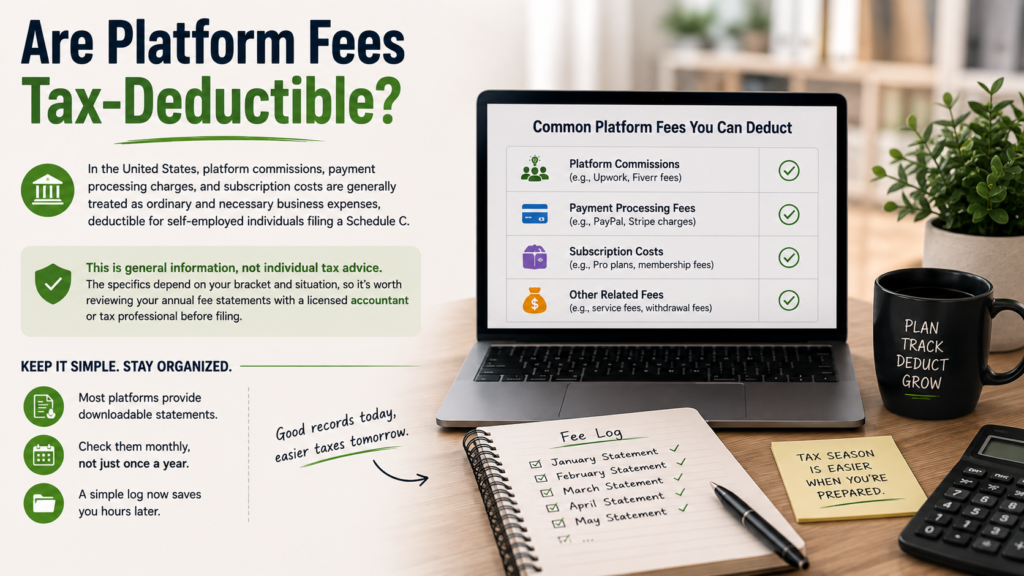
In the United States, platform commissions, payment processing charges, and subscription costs are generally treated as ordinary and necessary business expenses, deductible for self-employed individuals filing a Schedule C. This is general information rather than individual tax advice, and the specifics depend on your bracket and situation, so it’s worth reviewing your annual fee statements with a licensed accountant or tax professional before filing.
Keeping a simple running log of fee statements throughout the year, rather than trying to reconstruct them all in April, makes this part of tax season considerably less painful. Most platforms provide downloadable statements; the habit that actually saves time is checking them monthly instead of once a year.
Common Freelancer Questions About Platform Fees
Is there one average platform fee freelancers can plan around?
Not really. Fees range from 0% commission with a paid-connects model on one end, up to a flat 20% on platforms like Fiverr, and 40% or more in effective cost on contest-based creative platforms. General marketplaces increasingly use variable models rather than a single flat rate, so a single industry-wide average is more misleading than useful.
Can a freelancer negotiate platform fees directly?
Almost never on major marketplaces, since these fee structures are set by policy rather than individual negotiation. What a freelancer can influence is which platform’s fee model fits their situation best, whether a premium subscription tier actually pays off at their volume, and how they price projects to account for the fee stack.
Do clients pay platform fees too?
Yes, on most major marketplaces. Clients commonly pay a separate marketplace or processing fee on top of what they pay the freelancer, and on some platforms, like Toptal, the client’s premium is effectively what funds a freelancer fee of 0%. This dual-sided structure is now the norm rather than the exception.
Does a lower commission always mean a better deal for a freelancer?
Not automatically. A platform advertising a lower headline commission can still cost more overall once processing fees, withdrawal costs, and proposal fees are factored in. The only reliable comparison is the full cost stack against your typical project size, not the single number in the marketing copy.
Final Thoughts for Every Freelancer
Platform fees are never just the single percentage advertised on a pricing page. Between commission, processing, withdrawal costs, subscriptions, and proposal fees, the real cost of using any given marketplace can look quite different once everything is added up. Understanding that full picture is what actually protects your income, not just picking whichever platform claims the lowest number.
The freelancers who do best over the long run aren’t necessarily on the platform with the smallest advertised fee. They’re the ones who know exactly what each platform costs them in practice, price accordingly, and revisit that math whenever a platform quietly changes its structure. Treat your fee stack the same way you’d treat any other recurring business expense: worth reviewing regularly, not just accepting by default.
