

Imagine two designers with almost identical portfolios. One has a waiting list. The other keeps refreshing their inbox, hoping for work. The gap between them usually comes down to soft skills for freelancers, not talent.
The busy designer replies quickly, explains things clearly and stays calm when feedback gets messy. Clients enjoy working with them, so they come back and tell their friends.
That’s good news, because people skills can be learned. This guide covers seven of them, with a small exercise for each one you can try this week.
Hard Skills Get You Hired. Soft Skills Get You Rehired.
Hard skills are what you sell: code, design, copy, bookkeeping. Soft skills are how you work with people while you deliver them.
Think communication, listening, reliability, problem-solving, flexibility and keeping your cool. You can’t put them in a portfolio, but clients feel them in every message.
Big employers care about this too. In the World Economic Forum’s Future of Jobs Report 2025 skills outlook, resilience, flexibility, creative thinking and empathy all sit among the core skills companies value most.
For a solo worker, the stakes are even higher. There’s no manager or account team to smooth things over, so soft skills for freelancers carry the whole client relationship.
Why Clients Quietly Judge Soft Skills for Freelancers
Clients rarely say it out loud, but they start judging you from the very first message.
How fast do you reply? Do you explain your process clearly? Do you ask smart questions before jumping in?
The first week of a project matters most. A kickoff summary, an on-time update and a calm response to the first round of feedback can earn more trust than a perfect portfolio.
Get those early moments right and clients relax. Strong soft skills for freelancers often decide whether a small trial turns into steady work.
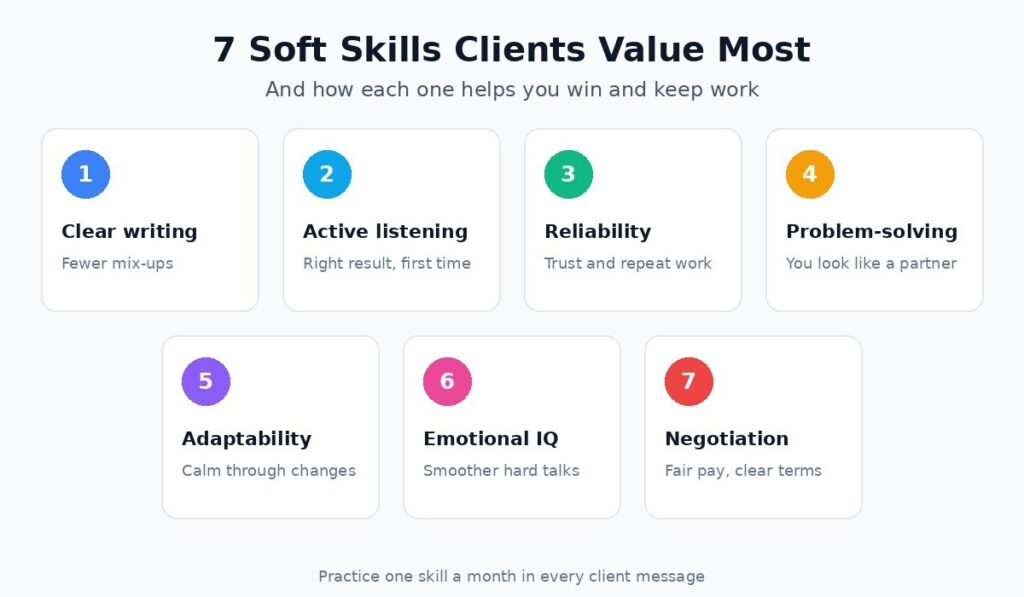
Alt text: Seven soft skills for freelancers and how each one helps win clients
1. Writing That Saves Everyone Time
Most freelance work happens in writing: emails, chat, project comments. Your messages are your tone of voice and your first impression rolled into one.
Lead with the main point. Use bullets for lists. End with a clear question or next step so the client knows exactly what to do.
After every call, send a short recap of what was agreed. It takes two minutes and prevents most “but I thought you said” moments.
Clear writing is easily the most visible of all soft skills for freelancers, since clients see it long before they see your finished work.
Try this: rewrite your last three client emails so each one is half as long. Notice what you could cut.
2. Listening for What the Client Really Means
A client asks for “a new homepage.” What they actually want is more sign-ups. Miss that, and you can deliver exactly what they asked for and still disappoint them.
The Center for Creative Leadership describes a handful of active listening habits: pay attention, hold back judgment, reflect what you heard, ask clarifying questions and summarize.
Harvard Business Review adds that active listening also means managing your own reactions and noticing nonverbal cues. On video calls, watch for a pause or a frown and ask about it.
Try this: on your next call, repeat the client’s goal back to them before you talk about solutions. “So the real aim is more sign-ups, right?”
3. Being the Person Who Always Delivers
Reliability tops many lists of soft skills for freelancers, because clients hire you to take stress away, not add to it.
Promise a little less than you think you can do, then deliver on time or early. If a delay is coming, say so before the deadline, never after.
A simple calendar and a short daily task list go a long way. Our time-saving hacks every freelancer needs can free up a few extra hours for the work that matters.
Try this: for one week, write down every promise you make to a client, then tick each one off when it’s done.
4. Bringing Solutions, Not Just Problems
Every project hits a bump. A plugin breaks, feedback is vague, a file goes missing. Clients remember how you handled it far longer than they remember the bump.
Instead of “The images are the wrong size,” try “The images don’t fit the template. I can resize these or create new ones. Which would you prefer?”
That small shift makes you look like a partner rather than a pair of hands. Clients notice, and they pay more for partners.
Try this: next time something breaks, don’t send the message until you’ve written at least one possible fix. It’s one of the simplest soft skills for freelancers to practice, and clients feel the difference right away.
5. Bending Without Breaking
Clients change their minds. Tools update overnight. Markets shift. Adapting calmly is one of the soft skills for freelancers that keeps you working while others stall.
Stay open to feedback and new ways of doing things. At the same time, protect your boundaries when a change affects the budget or the deadline.
Our guide to handling scope change without losing money shows how to stay flexible and still get paid fairly.
Flexibility applies to your skills as well. Keep an eye on the warning signs your skill has peaked so you can adjust before demand drops.
Try this: when a client changes direction, reply with what the change means for time and cost before you start. Clear, early numbers keep everyone friendly.
6. Keeping Your Cool When Things Get Tense
Emotional intelligence means noticing your own feelings, managing them and picking up on how other people feel. It’s what protects a relationship when something goes wrong.
It helps you stay steady when feedback stings and spot the frustration hiding behind a one-line email.
When a client is upset, name the concern before you jump to fixes. “I understand this delay puts your launch at risk” can lower the temperature straight away.
Try this: when a message annoys you, wait at least 30 minutes before replying. Read your draft once more as if you were the client.
7. Talking About Money Without Flinching
Plenty of talented people dread money conversations, even though negotiation belongs on any list of soft skills for freelancers. Avoiding it quietly costs them every year.
Negotiating isn’t about being pushy. It’s about explaining your value, listening to the client’s budget and finding terms that work for both of you.
Set clear boundaries on hours, revisions and payment, and put them in writing so nobody’s confused later.
Late payments test this skill most. Our guide to handling late-paying clients includes polite, firm wording you can borrow.
Try this: say your rate out loud a few times before your next call. It feels silly, but it makes the real conversation much easier.
Same Message, Better Soft Skills for Freelancers
Small changes in wording can change how a client feels about you. Here are a few everyday examples:
| Instead of | Try |
| “That’s not in the scope.” | “Happy to add that. It’s outside the current scope, so here’s a quick quote.” |
| “I’ll try to finish by Friday.” | “You’ll have it Friday by 3 p.m. your time.” |
| “There’s a problem with the files.” | “Two files are missing. Could you resend them, or should I use placeholders?” |
| “Any feedback?” | “Does the headline match the tone you want, or should it be more playful?” |
Notice the pattern: each version is specific, calm and gives the client an easy next step.
How to Build Soft Skills for Freelancers Over Time
Like any skill, soft skills for freelancers get better with practice and honest feedback. You don’t need to fix all seven at once.
- Pick one skill each month.
- Read or watch one short piece about it each week.
- Practice it in every client message and call.
- Ask a trusted client or friend for honest feedback.
- Note what worked and what you’ll change.
Courses can help, but choose carefully. Our honest look at free vs. paid courses can save you money, and the step-by-step roadmap to master any freelancing skill works just as well for people skills.
What about AI tools?
AI can tidy grammar, suggest clearer wording and summarize long calls. Our list of AI tools to stay competitive covers some good ones.
Just don’t let it replace the soft skills for freelancers that clients actually pay for. Always edit AI drafts until they sound like you.
Video Calls: Where Soft Skills for Freelancers Show Fastest
A 20-minute call reveals more about you than a week of emails. A few habits make a big difference:
- Test your camera, mic and internet five minutes early.
- Send a short agenda before the call.
- Let the client talk first, and take notes.
- Sum up decisions and next steps before you hang up.
- Send a written recap within a few hours.
None of these take long. Clients mention them in reviews more often than you’d expect.
Where to Start This Week
You don’t need a personality makeover. You need one small habit, practiced on purpose.
Pick the skill from this list that made you wince a little. That’s probably the one with the biggest payoff.
Practice it with every client for the next month. Small, steady improvements in soft skills for freelancers turn one-off projects into long-term partnerships.
Still deciding which technical skill to pair them with? Read how to choose the right freelancing skill, or explore our Skill Development & Learning category.
