

Freelancer income doesn’t come with a manual. One month you’re juggling three invoices, the next you’re wondering whether you’re even running your business the “right” way — legally speaking. Somewhere between the second contract and the first serious tax season, almost every freelancer hits the same fork in the road: keep working as a sole proprietor, or take the leap into an LLC. It sounds like a small paperwork decision, but it actually touches your taxes, your personal liability, and how seriously clients take you.
This guide breaks down what a freelancer actually needs to know before making that call, using real trade-offs, official guidance, and opinions pulled from freelancers who’ve already argued this exact question out on Reddit.
1. Why Every Freelancer Eventually Faces This Question
If you’ve started taking on paid work and haven’t filed any formation paperwork, you are already operating as a sole proprietor. That’s not really a choice — it’s the default. The moment a client’s payment lands in your account, tax authorities treat you as a one-person business by default, no forms required.
There’s nothing wrong with that on its own. Plenty of freelancers run comfortable six-figure businesses this way for years. But the default status also means there’s no legal wall between your business and your personal finances. If a client sues over a missed deadline, a security issue, or a piece of content gone wrong, your savings, car, and even your home could technically be on the table.
It also affects how you’re perceived. Some corporate clients, agencies, and procurement departments simply won’t cut a check to an individual — they need to pay a registered business, full stop. Others don’t care at all and are happy to work with an individual under their own name for years. Knowing which type of client you’re chasing can shape this decision just as much as your tax situation does.
2. Sole Proprietorship: The Default Freelancer Status
A sole proprietorship isn’t a bad option — it’s just an unprotected one. Here’s what it actually looks like in practice:
- No formation paperwork or state fees — you’re automatically a sole proprietor the day you invoice a client.
- Simple taxes — business income and losses are reported directly on your personal tax return.
- Zero liability protection — your personal assets are exposed if the business owes money or gets sued.
- Full self-employment tax — you pay both the employer and employee share of Social Security and Medicare.
For a new freelancer testing the waters, or someone doing low-risk work on the side, sole proprietor status is often perfectly reasonable. The trouble starts once the income — and the risk — starts to grow.
3. What an LLC Actually Changes for a Freelancer
A limited liability company, or LLC, is formed at the state level and creates a legal separation between you and your business. According to the SBA, this structure combines the liability protection of a corporation with the simpler tax treatment of a sole proprietorship or partnership — which is exactly why it’s such a popular pick among independent workers.
Forming a single-member LLC as a freelancer typically brings a few concrete advantages:
- Asset protection — your house, car, and personal savings are generally shielded from business debts and lawsuits.
- More tax flexibility — you can elect S-corp taxation once your income justifies it, potentially lowering your self-employment tax bill.
- A more professional appearance — some agencies and larger companies will only work with a registered business entity.
- Room to grow — an LLC makes it easier to get an EIN, open a business bank account, and eventually bring on subcontractors.
It’s not all upside, though. An LLC comes with state filing fees, sometimes annual renewal costs, and a bit more bookkeeping. If you mix personal and business funds carelessly, you can also lose the very liability protection you formed the LLC to get in the first place.
4. What Freelancers on Reddit Actually Say
This exact debate comes up constantly in freelance communities online, and the general consensus is more nuanced than “always form an LLC.” A widely discussed thread among freelancers lays out a pretty consistent pattern of opinions worth knowing before you decide.
A common thread: many experienced freelancers say the LLC decision comes down to income and risk, not fear. Several people pointed out that below a certain yearly income — often cited somewhere in the tens of thousands of dollars — the cost and hassle of maintaining an LLC can outweigh the benefit, especially in low-liability fields like writing or design.
On the other side, freelancers working in higher-risk areas — think software development, consulting, or anything involving contracts with real financial stakes — tend to say the liability protection alone is worth the paperwork. A few commenters also mentioned using an LLC mainly for practical reasons: separating business banking, looking more legitimate on invoices, or simplifying bookkeeping, rather than purely for legal protection.
The overall takeaway from these freelancer discussions is refreshingly unglamorous: there’s no universal right answer, and the decision should track your actual income, your industry’s risk level, and how much you personally value the peace of mind that comes with a legal buffer.
5. What LLC Paperwork Actually Involves
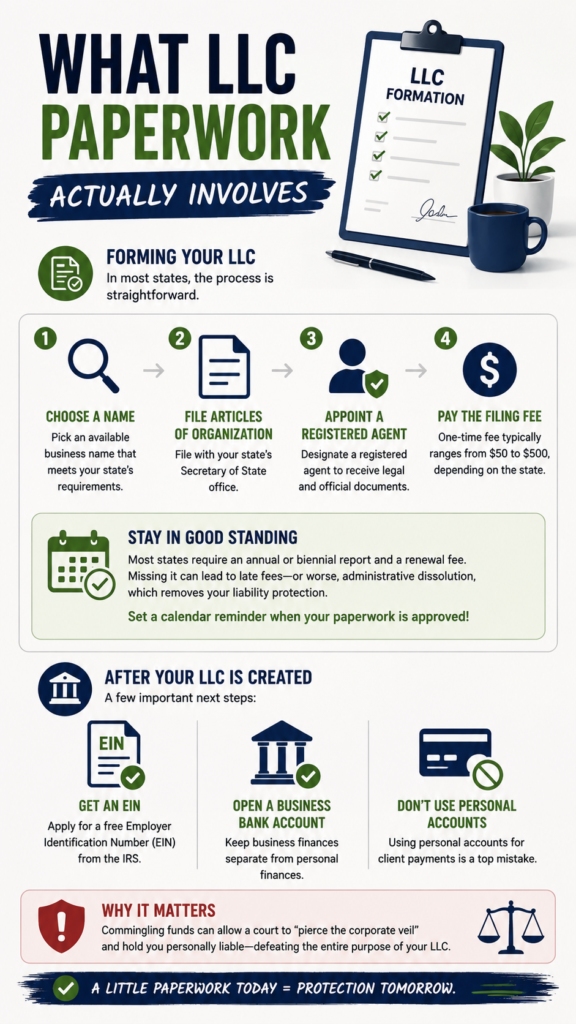
One reason freelancers put off this decision is that LLC formation sounds more complicated than it usually is. In most states, the process comes down to a handful of steps: choosing an available business name, filing Articles of Organization with your state’s Secretary of State office, appointing a registered agent, and paying a one-time filing fee that typically ranges from about $50 to $500 depending on the state.
After that, many states require an annual or biennial report along with a renewal fee to keep the LLC in good standing. Skipping that step doesn’t just risk a late fee — it can cause the state to administratively dissolve your LLC, which quietly strips away the liability protection you formed it for in the first place. It’s a good idea to set a calendar reminder the moment your paperwork is approved.
Once the LLC exists, a freelancer should apply for a free Employer Identification Number from the IRS, open a dedicated business bank account, and stop using a personal account for client payments. Skipping this last step is one of the most common mistakes — commingling funds is exactly the kind of behavior that lets a court “pierce the corporate veil” and hold you personally liable anyway, defeating the entire purpose of the LLC.
6. When It Actually Makes Sense for a Freelancer to Form an LLC
A few signals tend to show up together when it’s genuinely time to make the switch:
- Your freelance income has become your primary or sole source of income.
- You’re bringing in more than roughly $30,000–$50,000 a year and expect that to continue.
- You work in a field with real liability exposure — development, consulting, coaching, or anything involving contracts and deliverables that carry financial risk for the client.
- You want to hire subcontractors or eventually bring on employees.
- A client specifically requires you to invoice through a registered business entity.
If two or more of these apply, it’s worth spending an afternoon researching your state’s LLC filing process — it’s usually far less complicated than it sounds, and the fee is often a few hundred dollars.
7. When Sole Proprietor Status Still Makes Sense
On the flip side, staying a sole proprietor is a completely rational choice when:
- You’re freelancing part-time or still testing whether this is a viable full-time path.
- Your work carries genuinely low liability risk.
- Your income is modest enough that LLC fees would eat into a meaningful chunk of your profit.
- You already carry professional liability insurance, which covers a good portion of the risk an LLC would otherwise offset.
There’s no shame in staying a sole proprietor for years. Plenty of established freelancers only convert to an LLC once their business has clearly outgrown the informal setup — and that’s usually the smarter order of operations anyway.
8. Taxes: The Part Every Freelancer Gets Wrong
Here’s something that surprises a lot of new freelancers: forming an LLC doesn’t automatically change how you’re taxed. By default, a single-member LLC is still taxed exactly like a sole proprietorship — profits pass through to your personal return, and you still owe self-employment tax on net earnings.
The real tax advantage kicks in only if you later elect S-corp status, which lets you split your income into a salary and a distribution, potentially reducing the amount subject to self-employment tax. That move usually only pays off once your net freelance income clears somewhere around $50,000–$60,000, since it adds payroll and accounting overhead.
Regardless of which structure you choose, the deductions available to you — home office, software subscriptions, a portion of your internet bill, health insurance premiums — are largely the same. If you haven’t nailed down how you’re actually handling taxes as an independent worker yet, that’s worth sorting out before you worry about entity structure at all.
9. Protecting Your Freelancer Income No Matter What You Choose
Whether you stay a sole proprietor or form an LLC, the entity type is only one piece of protecting yourself as a freelancer. A few habits matter just as much:
- Keep a dedicated business bank account, even as a sole proprietor — it makes bookkeeping and taxes dramatically easier.
- Use written contracts on every project, not just the big ones, to spell out scope, payment terms, and liability.
- Consider professional liability insurance, which can cover gaps an LLC alone doesn’t.
- Build a cash reserve so a slow month or a legal hiccup doesn’t sink your business. A solid emergency fund does more day-to-day risk reduction than most people expect.
None of these replace the legal protection an LLC offers, but together they cover a lot of the everyday risk that keeps freelancers up at night — regardless of which business structure sits on your tax forms.
10. LLC Alternatives Every Freelancer Should Know About
An LLC isn’t the only middle ground between “do nothing” and “full corporation.” A few freelancers land on other setups depending on their goals:
- DBA (“Doing Business As”) — lets a sole proprietor operate under a business name without forming a separate legal entity. It’s cheap and simple, but offers no liability protection at all.
- S-corp election — not a business structure on its own, but a tax election an LLC (or corporation) can make once income is high enough to justify the added payroll complexity.
- Professional liability insurance — sometimes used instead of, or alongside, an LLC to cover claims related to errors, missed deadlines, or client disputes.
None of these fully replace what an LLC does, but they’re worth knowing about because a lot of freelancers assume it’s an all-or-nothing choice when it isn’t.
11. Common Freelancer Questions About LLCs and Sole Proprietorships
A few questions come up often enough that they’re worth answering directly.
Does an LLC make a freelancer look more professional to clients? Often, yes — some corporate clients and agencies require vendors to invoice through a registered business, and a company name can read as more established than a personal name on an invoice.
Can a freelancer switch from sole proprietor to LLC later? Absolutely, and it’s extremely common. Most freelancers start as a sole proprietor by default and convert once their income or risk profile changes. There’s rarely a downside to waiting until the numbers make the case for you.
Is an LLC required to freelance legally? No. A sole proprietorship is a fully legal way to run a freelance business — an LLC is optional, not mandatory, and choosing not to form one doesn’t put you outside the law.
12. Real-World Scenarios: Which Structure Fits?
Sometimes the decision is easier to see through examples than through rules. Here are three common situations independent workers run into:
The side-hustle writer. Someone writing blog posts a few hours a week alongside a full-time job, earning around $8,000 a year. The liability risk is minimal, the income doesn’t justify state fees, and sole proprietor status is the practical choice until the workload grows significantly.
The full-time developer. Someone building software for paying clients, earning $80,000 a year with contracts that include financial penalties for missed deadlines. Between the income level and the contractual risk, forming an LLC — and possibly electing S-corp taxation — is a much easier case to make.
The growing design studio. Someone who started solo but now subcontracts two other designers on bigger projects. Hiring help, signing larger contracts, and handling client funds all point toward an LLC, both for liability protection and for the more polished business presence it gives when pitching bigger clients.
None of these examples are prescriptive — plenty of writers earn well past six figures, and plenty of developers stay comfortably as sole proprietors for years. What matters is matching the structure to your actual income, risk, and growth plans rather than copying what worked for someone else in a completely different situation.
The Bottom Line for Freelancers
There’s no single correct answer to the LLC-versus-sole-proprietor question, and any freelancer who tells you otherwise is probably speaking from their own situation, not yours. Sole proprietorship is simple, cheap, and fine for lower-risk, lower-income work. An LLC costs more up front but buys real legal separation once your income and liability exposure grow.
The smartest move is to revisit the decision periodically rather than treating it as permanent. Plenty of successful freelancers start as sole proprietors, prove out their business, and convert to an LLC once the numbers — and the risk — actually justify it. Wherever you land, the goal is the same: build a freelance business that protects you as well as it pays you.
