
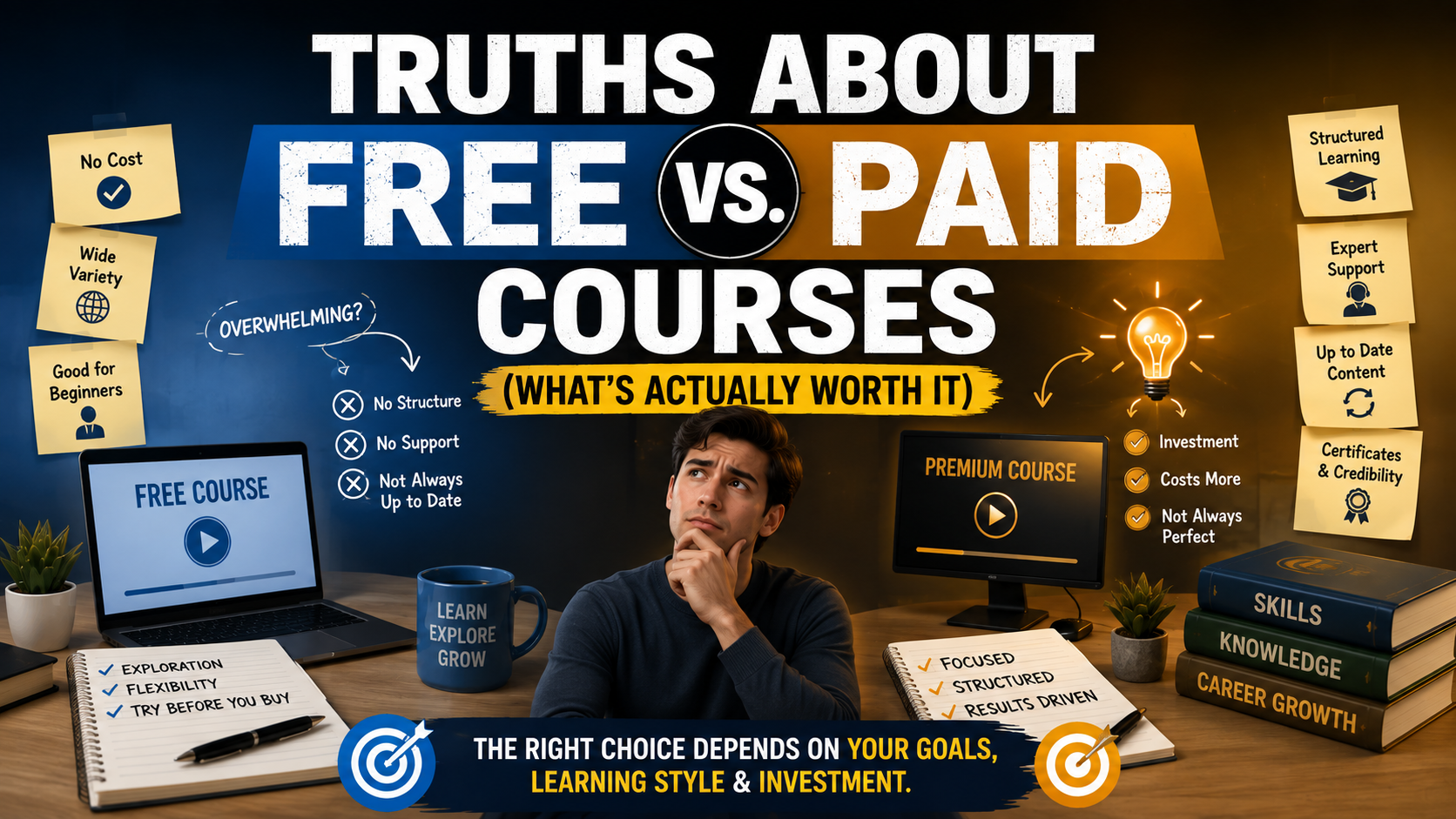
A no-fluff breakdown of when free learning is enough — and when paying actually pays off.
Every freelancer eventually hits the same wall: you want to learn a new skill, upgrade an old one, or finally understand something you’ve been faking for months, and you’re staring at two tabs — one open to a free YouTube tutorial, the other to a $200 course with a countdown timer telling you the discount ends in four hours. It feels like a small decision. It usually isn’t, because how you spend your learning budget shapes how fast you can raise your rates and take on better work.
This isn’t a marketing pitch for any course platform, and it isn’t a “free is always better” rant either. It’s a practical look at what free and paid courses each actually deliver, based on how people who learn for a living — largely through trial, error, and yes, wasted money — talk about it.
Why This Decision Is Harder for a Freelancer Than for an Employee
If you work a salaried job, a company might cover your training budget, and a bad course is just an afternoon lost. A freelancer doesn’t have that cushion. Every hour spent learning is an hour not billed, and every dollar spent on a course is a dollar that didn’t go toward rent, taxes, or that emergency fund you keep meaning to build. That changes the math entirely.
It also means the real question isn’t “which is better, free or paid?” It’s “which one gets me paid faster, with the least wasted time?” Those are different questions, and most articles on this topic answer the wrong one.
What Free Courses Actually Give a Freelancer
Free resources have gotten genuinely good over the last few years. YouTube channels, official documentation, free tiers on platforms like freeCodeCamp, and community-run tutorials now cover most beginner and even intermediate ground in coding, design, writing, and marketing.
Here’s what free content is genuinely good at:
- Testing interest before committing money. If you’re a freelancer not sure whether you’ll enjoy copywriting or graphic design, free content lets you find out without financial risk.
- Covering fundamentals. Basic syntax, core concepts, and standard workflows are widely documented for free, especially in programming and design.
- Staying current. Free content updates fast because creators aren’t locked into a fixed curriculum they paid to produce months ago.
One developer summed this up plainly in a discussion on Reddit about paid versus free programming courses: free material gets you through the basics just fine, but it tends to leave gaps that only show up once you try to build something real on your own. That gap is exactly where a lot of freelancers get stuck.
Where Free Courses Fall Short
The honest downside of free learning for a freelancer isn’t quality — plenty of free content is excellent. The problem is structure. Free tutorials are scattered across dozens of creators, none of whom agreed on a curriculum, so you end up piecing together knowledge instead of building it in order.
Common complaints from people who’ve tried to learn a skill entirely for free include:
- No clear path from “I understand this concept” to “I can deliver this to a client.”
- No feedback loop — nobody checks your work or tells you what a professional would fix.
- Outdated or contradictory advice mixed in with good advice, and no easy way to tell which is which as a beginner.
- No accountability, so courses started with enthusiasm get abandoned halfway through.
For a freelancer trying to land their first few clients, that missing feedback loop matters more than people expect. Clients don’t grade you on effort. They judge finished work, and free content rarely tells you whether your finished work is actually good.
What You’re Really Paying For With a Paid Course
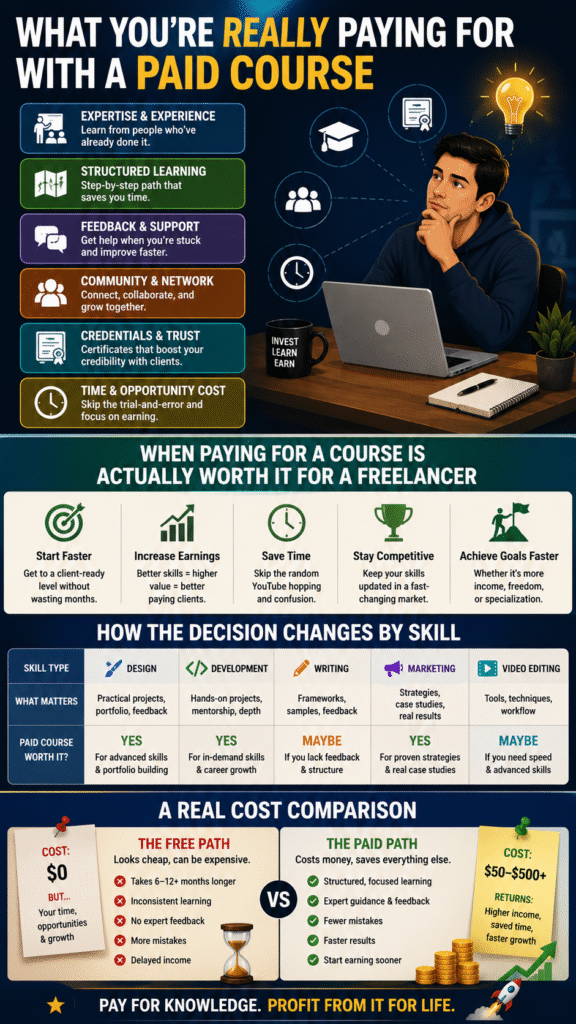
When a course costs money, you’re not paying for information that doesn’t exist elsewhere for free — you’re paying for someone else to have already organized it. That’s the whole value proposition, and it’s worth every freelancer being clear-eyed about it.
Specifically, a well-made paid course usually offers:
- A tested sequence. Someone has already figured out the order that makes concepts click, instead of you guessing.
- Depth on advanced topics. Free content thins out fast once you go past the basics; paid courses often dig further because the creator was compensated to bother.
- Direct feedback or a community. Some paid courses include instructor review, peer critique, or a private group where people actually answer questions.
- A finished project or portfolio piece. Many are built around producing something tangible you can show a client, not just knowledge you can recite.
A developer writing on DEV Community made a similar point about paid content: it tends to act as an all-in-one resource, saving the learner from hunting across ten different sites to fill in the gaps a single free video left behind.
When Paying for a Course Is Actually Worth It for a Freelancer
Not every paid course earns its price tag, and plenty are repackaged free information with a nicer thumbnail. But there are specific situations where paying makes sense.
1. You’ve hit a wall free content can’t get you past
If you’ve watched five different free tutorials on the same topic and still can’t apply it, that’s not a sign you need a sixth video. It’s a sign you need structure, and that’s usually what paid courses are built to provide.
2. The skill has real earning potential attached
If mastering something will let you raise your rate or take on higher-paying projects, a $50–$150 course that shortens your learning curve by weeks can pay for itself with a single client.
3. You need a portfolio piece, not just knowledge
Courses built around a real project — a website, a brand identity, a written campaign — hand you something to show, not just something you understood.
4. You’re not disciplined enough to finish free content alone
Paying money creates a small sense of obligation. If you’ve abandoned three free courses already, that psychological nudge might be worth the price on its own.
How the Decision Changes by Skill
“Free vs. paid” doesn’t play out the same way across every field, and a freelancer weighing a coding bootcamp faces a different calculation than one weighing a copywriting course. It helps to break it down by skill type.
Coding and web development
This is the field with the strongest free ecosystem. Full curriculums exist for free through platforms like freeCodeCamp, along with official documentation for nearly every language and framework. The Reddit thread referenced earlier, sitting in a programming-focused community, reflects exactly this — most commenters agreed free resources cover the fundamentals well, and paid courses only start earning their price once you’re chasing a specific framework, certification, or a structured project you can put in a portfolio.
Design and creative skills
Design tools themselves (Figma, Canva, and even parts of Adobe’s suite) have decent free tutorials, but design theory — composition, color, typography, client communication — is thinner in free content. This is one area where a mid-priced paid course, built around a real brief, often produces a stronger portfolio piece than months of scattered free tutorials.
Writing and copywriting
Writing is arguably the cheapest skill to learn for free, since practice and feedback from real editors or peer groups often matter more than formal instruction. A freelancer starting in copywriting can usually get further with free swipe files, style guides, and practice than with an expensive course, unless the course includes direct feedback on actual client-style assignments.
Marketing and business skills
This is where paid courses tend to justify themselves most consistently, because good frameworks for pricing, positioning, and client acquisition are scattered and inconsistent across free blogs. A focused paid course from someone with a verifiable track record can save weeks of trial and error here.
A Real Cost Comparison
Numbers make this less abstract. Say a freelancer charges $35 an hour and is deciding between two paths to learn a new skill:
- Path A — fully free: Roughly 40 hours spent piecing together tutorials, with an estimated 10 of those hours lost to dead ends, outdated advice, or re-learning something explained badly the first time. Direct cost: $0. Opportunity cost: real, but invisible.
- Path B — one well-chosen paid course: A $120 course that compresses the same material into 15 focused hours, including a project to show clients. Direct cost: $120. Time saved: roughly 25 hours.
If those 25 saved hours go toward billable work instead, that’s $875 in potential earnings against a $120 spend. That math doesn’t hold for every course or every skill, but it’s the kind of back-of-envelope thinking worth doing before buying anything — and it’s also the kind of thinking that shows why “free is always cheaper” isn’t quite true once your time has a dollar value attached to it.
How to Evaluate a Paid Course Before You Buy
Since a bad paid course wastes both money and time — two things a freelancer can’t spare — it’s worth checking a few things before checking out:
- Look for a syllabus, not just a sales page. If the seller won’t show you what’s actually covered, that’s a signal to walk away.
- Check the instructor’s actual work. Someone teaching client acquisition should be able to show real clients. Someone teaching design should have a real portfolio.
- Search for the course name plus “review” or “worth it”. Independent opinions, including ones buried in forum threads, are usually more honest than testimonials on the sales page itself.
- Check the refund policy. A course confident in its own value usually offers some kind of guarantee.
- Ask what you’ll have at the end. A certificate is nice; a finished project you can send to a client is worth more.
What Other Freelancers and Learners Actually Say
Beyond the programming-focused Reddit discussion mentioned earlier, the same debate shows up across career forums in a pretty consistent pattern. Some learners argue paid courses are worth it mainly for the structure and real-time feedback, since free material tends to leave you filling gaps on your own. Others point out that free and paid content end up covering nearly identical ground at the beginner and intermediate level, and that the real difference only shows up with certificates, advanced modules, or personalized mentorship. A recurring theme across nearly all of these opinions: paying for a course rarely replaces the need to just start doing real work, free or not.
That last point matters most for a freelancer. Clients don’t ask which course you took. They ask what you can deliver, and no amount of course-hopping substitutes for finishing actual projects, even small or unpaid ones at first.
A Simple Framework: Free First, Paid With Purpose
Most experienced freelancers land on a version of the same approach, whether they planned it that way or stumbled into it:
- Start free. Use free resources to figure out if you actually enjoy the skill and can grasp the basics.
- Identify the specific gap. Once you hit a wall, name exactly what’s missing — advanced technique, structure, feedback, or a portfolio piece.
- Buy narrowly. Choose a paid course that fixes that specific gap rather than a broad “master everything” bundle.
- Treat it as an investment, not a purchase. Track whether the course actually led to paid work. If it didn’t within a reasonable window, that’s useful information for next time.
This mirrors advice from a roadmap that experienced freelancers often describe: don’t buy a course to feel productive. Buy it to solve a problem free content couldn’t.
Red Flags to Watch for in Both Free and Paid Courses
For a freelancer, price alone doesn’t guarantee quality in either direction. Before committing time or money, check for these warning signs:
- Reviews that are all suspiciously recent or generic — a sign of fake testimonials.
- No preview lessons or syllabus, so you’re buying blind.
- Content that hasn’t been updated in years, especially in fast-moving fields like design tools or programming frameworks.
- Promises of guaranteed income or clients — no course can honestly promise that.
The Honest Verdict
Neither option wins outright, and anyone who tells a freelancer otherwise is probably selling something. Free courses are the right starting point for almost everyone — cheap, low-risk, and good enough to build real fundamentals. Paid courses earn their place later, when you know exactly what gap you’re trying to close and the return on closing it is clear.
The freelancers who waste the least money aren’t the ones who avoid paid courses altogether, and they aren’t the ones who buy every bundle in a flash sale either. They’re the ones who treat every course — free or paid — as a tool with a specific job, not a substitute for actually doing client work and learning from it.
That, more than any curriculum, is what tends to move a freelancer from “still learning” to “getting paid.”
