

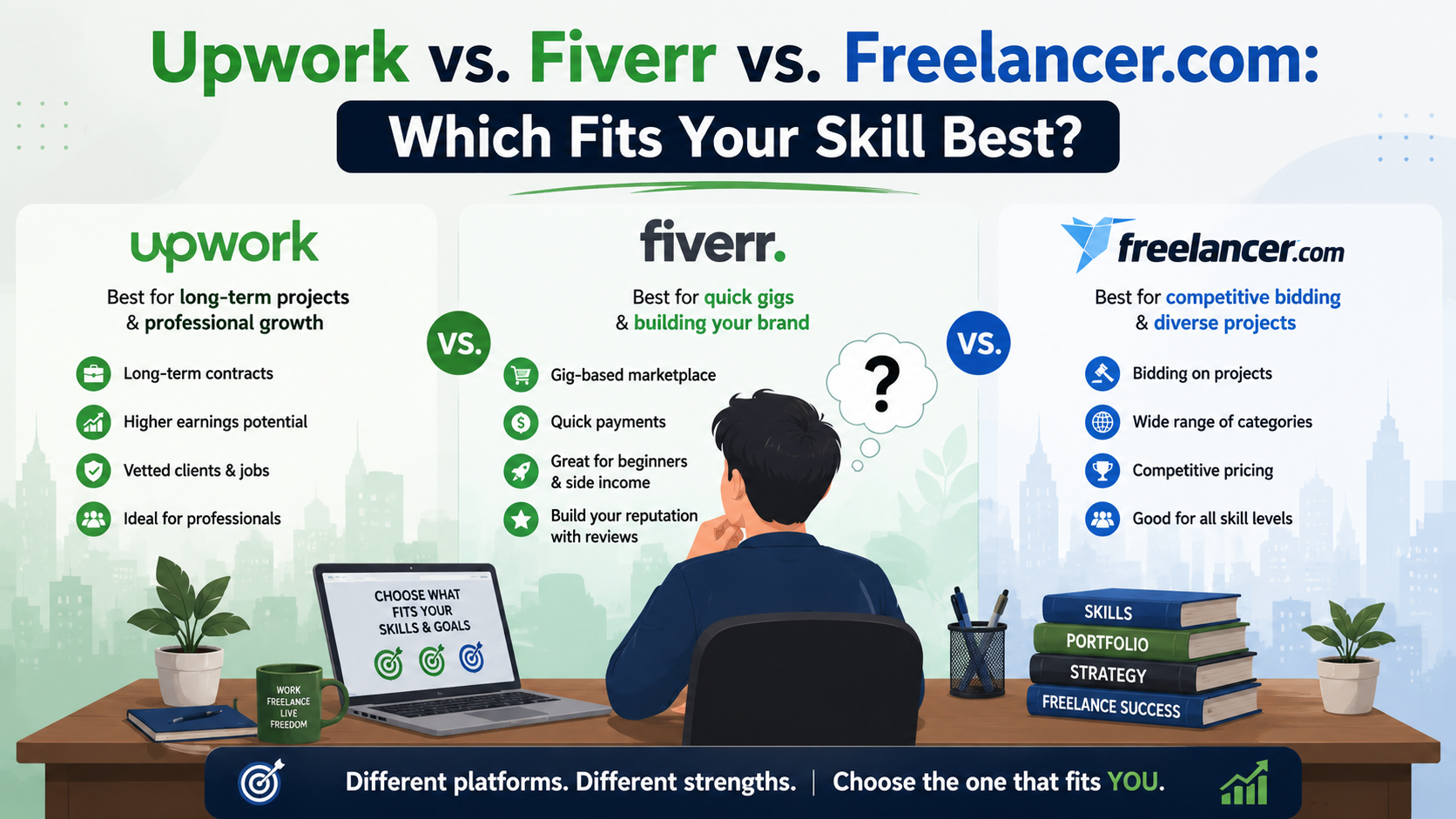
Upwork vs. Fiverr vs. Freelancer.com — which one actually fits the way you work?
If you’ve spent any time searching “best site for freelancers” on Google, Reddit, or Quora, you already know the answer isn’t simple. Every independent professional swears by a different platform, and every platform swears it’s the best one for you.
The truth is more practical than that. Upwork, Fiverr, and Freelancer.com are built around different workflows, different fee structures, and different types of clients. The “best” one depends entirely on what kind of freelancer you are — not on which platform has the flashiest homepage.
This article breaks down the real differences between the three, based on current fee data, platform mechanics, and the kind of feedback contractors actually share in community forums like Reddit and Quora.
Quick Overview: How Each Platform Works
Before comparing fees or earning potential, it helps to understand the basic mechanics. Each platform hands control to a different party.
Upwork runs on a proposal system. A client posts a job, and professionals submit bids using “Connects” — a limited currency that costs money to spend. The client picks who they want to interview or hire.
Fiverr flips that model. A freelancer builds a “Gig” — a packaged service with a fixed scope and price — and clients browse and buy directly, similar to online shopping.
Freelancer.com works more like a hybrid. Clients post projects or contests, and applicants bid competitively, often against dozens of other applicants within minutes of a project going live.
None of these approaches is objectively superior. Someone who thrives writing detailed proposals on Upwork might feel completely lost trying to package a Fiverr Gig, and vice versa.
Fees: What Every Freelancer Actually Takes Home
This is usually where the decision actually gets made, so let’s look at the numbers as they stand in 2026.
Upwork’s Sliding Scale
Upwork uses a tiered commission structure per client relationship:
- 20% on the first $500 billed to a single client
- 10% on earnings between $500.01 and $10,000
- 5% on everything above $10,000
This means every 1% increase in platform commission tends to push rates up by roughly 0.7%, since workers pass part of the cost on to clients. In practice, someone who builds a long-term relationship with one client ends up paying far less than a one off contractor chasing one-off gigs.
Fiverr’s Flat Rate
Fiverr applies a flat 20% commission on every transaction, regardless of order size or client history. There’s no volume discount for loyalty. On top of that, buyers pay their own 5.5% service fee, which can nudge total project costs higher and occasionally makes clients negotiate the freelancer’s price down.
Freelancer.com’s Structure
Freelancer.com typically takes around 10% commission from sellers, while clients are charged roughly 3% on awarded projects, with a minimum fee. It sits in the middle ground between Upwork’s tiered system and Fiverr’s flat cut.
The Bottom Line on Fees
| Platform | Freelancer Fee | Client Fee |
| Upwork | 5%–20% (sliding scale) | ~3–10% |
| Fiverr | Flat 20% | ~5.5% + small flat fee |
| Freelancer.com | ~10% | ~3% (minimum applies) |
No platform lets a freelancer keep 100% of what they earn. The real question is which fee structure rewards your working style — repeat clients, one-time gigs, or competitive bidding.
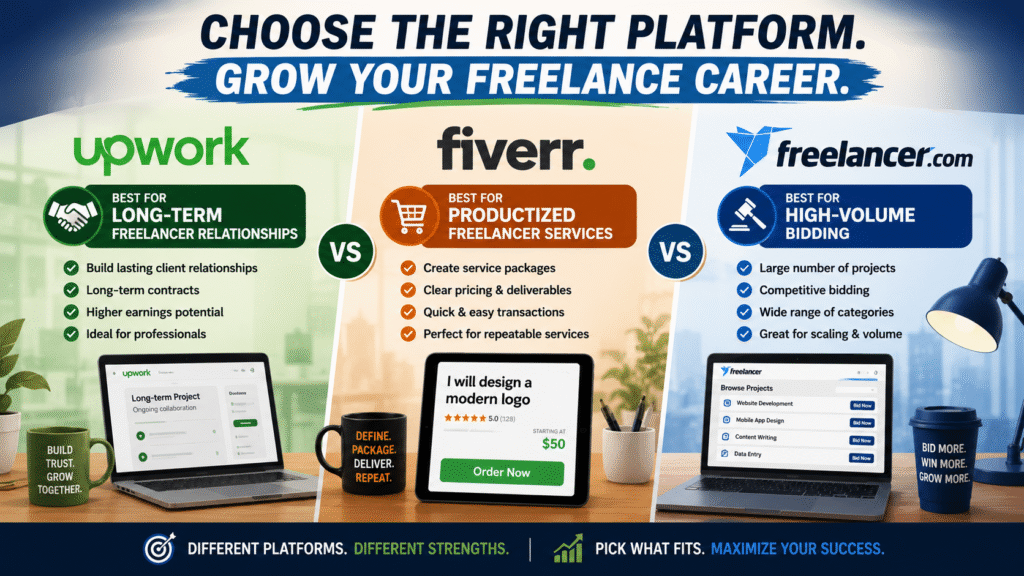
Upwork: Best For Long-Term Freelancer Relationships
Upwork currently generates a substantial share of its revenue from marketplace activity, with several hundred thousand active clients spending billions annually. That scale matters — it means there’s genuine budget behind the job postings, not just bargain hunters.
Upwork tends to suit a someone who:
- Prefers writing custom proposals over pre-set packages
- Wants ongoing, retainer-style work rather than single transactions
- Works in fields like development, writing, consulting, or design where trust builds over time
- Doesn’t mind investing time upfront vetting clients and negotiating scope
Upwork also reports a median income of $85,000 for full-time workers on the platform, though that figure reflects established freelancers with strong profiles, not newcomers in their first month.
The trade-off: Upwork’s Connects system means every proposal costs something, even if you don’t land the job. With 15–40 proposals typically submitted per job posting, competition can be steep for a new freelancer without reviews yet.
Fiverr: Best For Productized Freelancer Services
Fiverr rewards a different kind of seller— one who can turn a skill into a repeatable, clearly scoped product.
On Fiverr, the client is in control of the hiring process from the start: they search, compare, and buy directly, often without ever messaging the seller first. That’s a major shift from Upwork’s proposal-heavy model.
Fiverr works well for someone who:
- Offers a service that’s easy to standardize (logo design, voiceovers, short-form video edits, simple copywriting)
- Wants to sell without writing individual pitches for every job
- Prefers speed over long back-and-forth negotiation
- Is comfortable competing on gig presentation, packaging, and reviews rather than a written proposal
The downside is the flat 20% commission, which hits low-priced gigs the hardest. A seller charging $15 for a task effectively earns $12 once Fiverr’s cut is applied — before accounting for time spent on revisions.
Freelancer.com: Best For High-Volume Bidding
Freelancer.com is known for speed — roughly two-thirds of bids on new projects arrive within the first 60 seconds of posting, across a reported base spanning 247 countries.
This platform suits someone who:
- Is comfortable bidding fast and often
- Works in categories with high volume, like data entry, basic design, or entry-level development
- Wants to compete globally on price as well as skill
- Doesn’t mind lower average project values in exchange for volume
Freelancer.com also runs contests, where multiple contestants submit work speculatively and only the winner gets paid. That format can build a portfolio quickly, but it also means unpaid work is baked into the model — something every bidder should weigh carefully before jumping in.
What Freelancers Say on Reddit and Quora
Community discussions on Reddit and Quora tend to echo the same patterns seen in the fee and workflow data above, just in more personal terms.
A common thread across contractor forums is that Upwork feels more “professional” but slower to break into, especially for anyone without existing reviews. New members frequently describe the first few weeks as the hardest part — proposals go unanswered, and Connects run out fast.
Fiverr, by contrast, gets described as faster to start but harder to stand out on, since so many gigs compete on price alone. Providers offering more specialized or creative skills tend to report better results than those offering generic, easily-copied services.
Freelancer.com discussions, including the kind referenced on Quora threads comparing these platforms, often mention that it can feel more saturated with very low bids, which pushes serious users toward Upwork or niche platforms instead — though plenty of people still use it successfully for quick, smaller-scope work.
The general sentiment isn’t “one platform is better.” It’s closer to: different platforms suit different skills, and most experienced freelancers eventually use more than one.
Which Platform Fits Your Skill?
Here’s a simplified way to think about it, based on what kind of freelancer you are today — not who you hope to become in a year.
Choose Upwork if:
- You offer a service that benefits from an ongoing relationship (development, strategy, writing, consulting)
- You’re comfortable writing tailored proposals
- You want access to higher-budget, longer-term clients
Choose Fiverr if:
- Your skill can be packaged as a clear, repeatable product
- You want clients to come to you instead of pitching them
- You’re building a portfolio and want quick turnaround work
Choose Freelancer.com if:
- You want to bid on a high volume of smaller projects
- You’re comfortable with fast-paced competition
- You’re open to entering contests to build credibility early on
Choose more than one if:
- You’re not sure yet — most freelancers eventually test two or three platforms before settling into the one that fits their skill and pace best.
Final Thoughts
There’s no universal winner in the Upwork vs. Fiverr vs. Freelancer.com debate, and any freelancer promising one is oversimplifying. Each platform was built around a different kind of transaction, and each one rewards a different way of working.
A freelancer chasing long-term, higher-value contracts will likely find Upwork worth the slower start. A freelancer with a tightly defined, sellable skill may do better packaging it as a Fiverr Gig. And a freelancer who thrives on speed and volume might get more traction bidding actively on Freelancer.com.
The smartest move, based on both the fee data and the recurring feedback from freelancer communities, is to treat these platforms as tools rather than identities. Test where your specific skill performs best, track your actual take-home earnings after fees, and adjust from there. That’s how most successful freelancers — regardless of platform — actually figured out what works.
