

Making the jump from a 9-to-5 to freelancer life sounds simple, until you actually try it.
What if I simply just left?
No more fluorescent lights. No more calendar full of someone else’s priorities. No more commute. All of it traded for something that actually felt like theirs.
Pivoting from a 9-to-5 to freelancer life can look easy on the surface. It rarely plays out the way anyone imagines while daydreaming at their desk. Some people plan the move a year in advance and still get caught off guard. Some quit on impulse and somehow land in a better spot. Some start out broke and work it out from there.
These five stories are real — pulled from interviews, personal essays, and firsthand accounts. None of them were smoothed over for the sake of a tidy narrative.
1. The Marketing Director Who Had Everything, and Left Anyway
Courtney Hartmann Tisa spent ten years climbing the marketing ladder. At the peak of her career, she’d negotiated a $20,000 raise and was working as a marketing director, taking on freelance work on the side just to scratch a different itch.
On paper, she had it made: financial stability, a paid-off car, money to travel.
But something wasn’t adding up. She didn’t feel the kind of impact a leadership role was supposed to give her. The daily commute, the office politics, the sense that she was doing “more of the same” with extra stress piled on, it all added up to a stability that stopped feeling worth it.
After landing one of her biggest promotions yet, she left her full-time job entirely and went all in as a freelancer, working as a copywriter, in 2019.
The strange part wasn’t the money. Her freelance income matched, and often beat, her old salary. The strange part was the free time. Most days she was done by 1 or 2 p.m., and that unstructured afternoon took real getting used to. She’s since described her days as feeling like she’s living retired in her 40s, running errands at 11 a.m. with barely any traffic, mostly surrounded by actual retirees.
The takeaway: leaving a 9-to-5 for freelancing doesn’t just change your income. It changes your entire relationship with time, and that shift can be just as disorienting as the financial risk.
2. The Gen Z Designer Who Skipped the 9-to-5 to Become a Freelancer
Not every freelance story starts with a dramatic resignation letter. Some people simply never took the traditional route to begin with.
Suzanne Ctvrtlik graduated into a rough job market for entry-level creative roles. Many of the full-time openings she found paid less than expected, were contract-based, or were tied to cities she couldn’t afford. None of them felt stable, and none matched the kind of work she actually wanted to do.
So she became a freelancer straight out of college, mostly out of necessity rather than any grand plan.
It turned out to be the better fit anyway. She built her income by focusing on long-term client relationships instead of constantly chasing new leads, staying consistent and easy to work with, and gradually raising her rates as her experience — and her sense of her own value — grew. Over time, she scaled her freelance design work into a six-figure income on Upwork.
She’s part of a bigger shift, too. 53% of skilled Gen Z knowledge workers are already freelancing in some form, and Gen Z is projected to make up roughly 30% of the US workforce by 2030.
The takeaway: for a growing number of people, freelancing isn’t a detour from the “real” career path. It’s becoming the starting point.
3. The Side Hustle That Quietly Made Her a Freelancer
Not everyone leaps. Some people ease in, one late night and one weekend at a time.
Tami Brehse spent months working nights and weekends on a side hustle before finally making the full leap into life as a freelancer, doing consulting work. By the time she made the switch, the side hustle had already proven itself. She wasn’t betting on an idea. She was formalizing something that was already working.
That gradual approach lines up with advice that shows up constantly in freelancer communities: don’t quit your job to start freelancing — start freelancing, and let it eventually justify quitting your job. Steady freelance income typically only comes once you’ve already built a pipeline of leads and repeat clients, and that pipeline takes time to develop while a paycheck is still cushioning the process.
The takeaway: the safest version of this transition usually isn’t dramatic. It’s slow, deliberate, and built quietly in the margins of a job you haven’t quit yet.
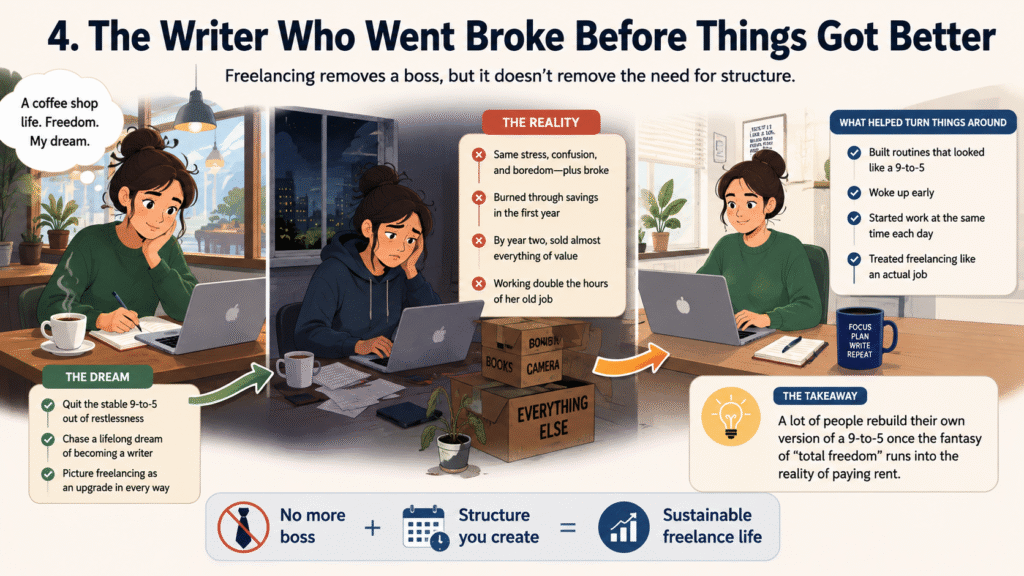
4. The Writer Who Went Broke Before Things Got Better
Not every story here is a straight line to freedom, and it wouldn’t be honest to pretend otherwise.
One freelancer, a writer, described quitting a stable, full-time job out of restlessness and boredom, chasing a lifelong dream of becoming a writer. She pictured herself in a coffee shop, effortlessly productive, and imagined freelancing as an upgrade to her old life in almost every way.
Instead, she got the same stress, confusion, and boredom she’d had before — except now she was also broke. She burned through her savings in the first year. By year two, she’d sold off nearly everything of value she owned except her laptop, and she was working double the hours she used to work at her old job.
Eventually, things did turn around, though she’s candid that quitting her job didn’t magically fix anything on its own. What helped was rebuilding routines that looked, ironically, a lot like a 9-to-5: waking up early, starting work around the same time each day, and treating freelancing like an actual job rather than an escape from having one.
The takeaway: freelancing removes a boss, but it doesn’t remove the need for structure. A lot of people rebuild their own version of a 9-to-5 once the fantasy of “total freedom” runs into the reality of paying rent.
5. The One Who Left for Autonomy, Not Money
Some career switches aren’t really about income or flexibility at all. They’re about who gets to make the decisions.
One freelancer, writing under the name Sarah Duran, put it plainly: she left her 9-to-5 because she was tired of people telling her what to do, how to do it, and what she was worth. She now runs her own freelance business and spends part of her time helping other solopreneurs through the same transition.
That motivation shows up constantly in freelancer surveys, too. In one widely cited Upwork study, roughly 60% of freelancers said they have no plans to ever return to a traditional 9-to-5 job, even accounting for the added income volatility that comes with freelance work. For a lot of people, trading steady pay for actual control over their schedule and decisions is a tradeoff they’d make again without hesitation.
The takeaway: money matters, but for a lot of freelancers, the real reason they never look back isn’t what they’re earning. It’s who’s in charge of their calendar.
What These Five Stories Actually Have in Common
Strip away the specifics, and a few patterns repeat across all five.
- Almost nobody’s transition matched their initial expectations, for better or worse.
- The people who eased in gradually tended to describe the process as smoother than the people who quit cold turkey.
- Structure didn’t disappear when the job did. Nearly everyone who found long-term success ended up rebuilding some version of a routine, even without anyone forcing them to.
- The financial risk was real for all of them, but it wasn’t always the hardest part. For more than one person here, the emotional adjustment to unstructured time was just as difficult as the income swings.
A financial cushion showed up in almost every account, one way or another. The people who had savings or side income to lean on described the transition as stressful but survivable. The one story with the roughest first two years was also the one where the savings ran out fastest — and that’s not a coincidence.
It’s probably the single most practical takeaway buried in all five stories: the leap itself is rarely what sinks people. Running out of runway before the freelance income catches up is.
If you’re weighing your own move from a 9-to-5 to freelancer life, it’s worth building the financial groundwork before you jump, not after. That means having contracts that actually protect you, a realistic sense of your monthly numbers, and a plan for income that doesn’t depend on a single client. Our guides on freelance contract clauses that protect you and passive income ideas for freelancers are a good place to start before you hand in your notice.
None of these five people had it all figured out on day one. What they had, eventually, was a system. That’s usually the actual difference between a freelance career that lasts and one that quietly fizzles out after six stressful months.
