

It’s 11 p.m. Your assignment is due Friday, your phone is buzzing with group chat messages, and you’re wondering how other students seem to earn real money online. For a lot of them, the answer is freelancing as a student.
It’s not magic, and it’s not a shortcut to quick riches. But with a useful skill and a sensible plan, you can earn steady side income, build a portfolio and graduate with real client experience.
This guide covers seven practical steps, plus a simple weekly plan that keeps your grades safe.
Is Freelancing as a Student Right for You?
Before you start, ask yourself three honest questions.
- Do you have 8 to 12 free hours a week? That’s a realistic amount for most students during term.
- Can you meet deadlines without reminders? Clients won’t chase you the way teachers do.
- Are you willing to start small? Your first projects may pay less while you build reviews.
If you said yes to all three, you’re in a good place. If not, you can still start, just slowly, perhaps during holidays first.
One rule matters before anything else. Most big platforms have age limits. Upwork’s page on who can join says you must be 18 or the age of majority in your country, whichever is older. Check each platform’s rules before you sign up.
1. Pick One Skill You Can Deliver This Month
The biggest mistake is trying to learn five skills at once. Pick one that you can deliver to a client within a few weeks.
Good starter skills for students include:
| Skill | Why it suits students |
| Content writing | Builds on essay skills you already use in class |
| Graphic design | Free tools like Canva make it easy to begin |
| Data entry and research | Flexible hours and simple tasks |
| Tutoring | Turns your strongest subject into income |
| Social media help | Many small businesses need it |
| Basic web or app coding | Great for computer science students |
Not sure which fits you? Read how to choose the right freelancing skill. Our post on how long it takes to earn with different skills also helps set realistic expectations.
2. Learn Fast Without Spending Much
You don’t need an expensive course to start freelancing as a student. Free videos, practice projects and feedback from classmates can take you surprisingly far.
Spend a month learning, then switch quickly to real work. Clients care about results more than certificates.
If you’re thinking about paying for a course, read our honest look at free vs. paid courses first. Many students waste money on courses they never finish.
3. Build a Small Portfolio From Class and Practice Work
“I have no experience” is the most common worry in freelancing as a student. The fix is simpler than it sounds.
Use what you already have. A strong class project, a redesign of your society’s poster, or a blog post you wrote for practice can all become portfolio samples.
Aim for three samples that match the work you want to get. Quality beats quantity every time.
4. Land Your First Clients Close to Home
When freelancing as a student, your first client is often someone you already know. Think about a relative’s small shop, a local tuition center or a university society that needs help with posts.
Do one or two of these projects at a fair, low price in exchange for a review or testimonial. That proof makes the next client much easier to win.
Once you have a couple of results, move onto marketplaces. Our guide to landing your first 5 reviews shows how to build momentum on a new platform.
5. Plan Your Week Around Classes, Not Clients
Your studies come first. Freelancing as a student only works if your schedule protects class time and exam weeks.
The University of Rochester’s time management tips recommend mapping out the whole semester’s deadlines and blocking your days in advance. Do the same with client work.
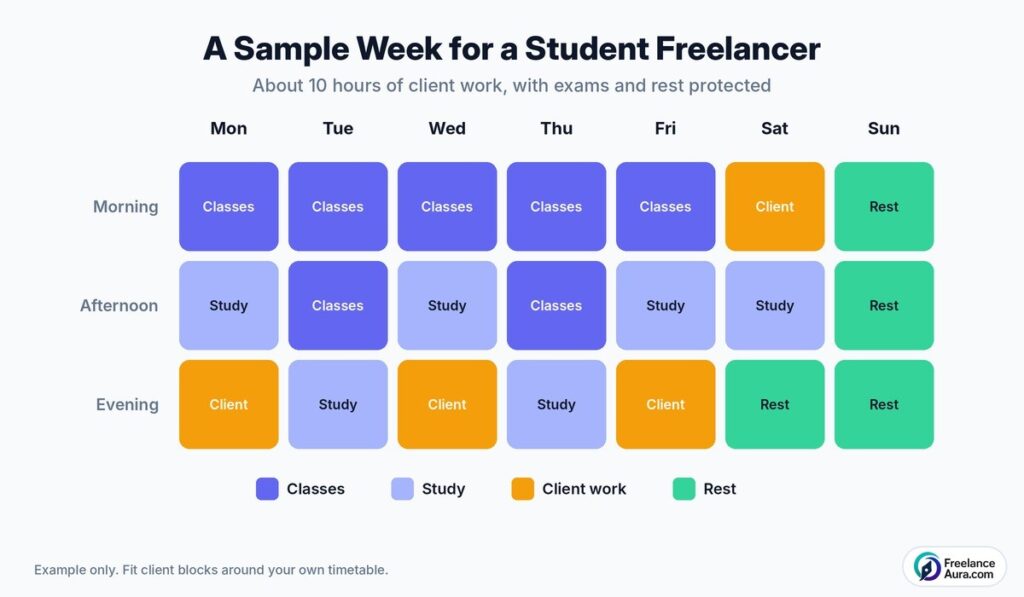
Alt text: Weekly plan for freelancing as a student showing classes, study time and client work blocks
In the example week above, client work sits in short blocks after classes and on Saturday morning. Sunday stays free for rest and catching up.
Harvard Summer School’s time management advice for students adds a useful point: build your schedule around your own energy levels and leave buffer time for surprises. If you’re sharpest at 7 a.m., that’s your best time for client work.
Short focus sessions help too. Try one of the methods in our guide to the Pomodoro method and its alternatives.
6. Handle Money and Safety Like a Professional
Scammers often target beginners, and freelancing as a student can make you an easy target if you don’t know the warning signs.
Real clients pay through the platform or a clear invoice. Be careful with anyone who asks for money upfront, sends a cheque you have to “return” part of, or wants to move every payment off the platform.
Set up a way to get paid before your first project, so you’re not scrambling later. Keep a simple spreadsheet of what you earn and what you spend.
It’s also smart to save a share of every payment. Depending on where you live, freelance income may need to be declared for tax, so ask a parent, a teacher or a local accountant how it works for you.
Never share your student ID, bank login or passwords with a client. A genuine business will never need them.
7. Protect Your Grades and Your Energy
Saying yes to everything is the fastest way to burn out. Freelancing as a student means learning to say “not this week” when exams are close.
Tell clients your availability upfront. Something like “I’m available 10 hours a week, with lighter weeks during exams” sets clear expectations from day one.
Watch for warning signs: missed lectures, poor sleep or falling grades. Our stories on overcoming freelancer burnout show how quickly exhaustion can creep up, even for experienced people.
Simple Tools That Make Life Easier
You don’t need much to get going. A few free tools cover most of what a beginner needs:
- A calendar app to block classes, study time and client work in one place.
- Google Docs or Drive to share drafts and keep files organized by client.
- Canva for quick graphics, social posts and simple portfolio pages.
- A notes app to track ideas, tasks and client feedback.
- A simple spreadsheet to log hours, payments and deadlines.
Keep your setup light. The best tools for freelancing as a student are the ones you’ll actually open between classes.
What Freelancing as a Student Can Look Like
Here are two example paths, based on patterns many students follow. Names and details are illustrative.
The writer
A second-year business student starts by writing blog posts for her cousin’s bakery. After three posts, she has samples and a testimonial. By the end of the semester, she writes two articles a week for a marketing agency, working around eight hours.
The coder
A computer science student fixes small bugs on WordPress sites during the summer break. During term he takes only one project at a time. By graduation, he has a dozen client reviews and a part-time contract that turns into a job offer.
Neither story is overnight success. Both are steady progress, which is exactly what makes them realistic. For more real-life journeys, read our 9-to-5 to freelancer career-switch stories.
Mistakes to Avoid When Freelancing as a Student
- Taking on big projects during exam season.
- Charging almost nothing for months and never raising your price.
- Working without any written agreement on scope and payment.
- Ignoring messages for days because of a busy week.
- Copying samples from the internet instead of making your own.
Most of these come down to planning. A short, honest message to a client is always better than silence, and a smaller workload is better than a missed deadline that costs you a review. Avoid these traps and freelancing as a student becomes much less stressful.
How Freelancing as a Student Helps After Graduation
The benefits don’t stop when you finish your degree. You leave university with real client results, references and a portfolio that most graduates simply don’t have.
Employers notice that. So do future clients. Some students turn their side work into a full-time freelance business, while others use it to land a better first job.
Either way, the habits you build while freelancing as a student, like managing deadlines and talking to clients, stay useful for the rest of your career.
Common Questions
How much can a student earn?
It depends on your skill, your hours and your market. Many beginners earn modest amounts at first, then grow as reviews and samples build up. Focus on learning and proof in the first few months.
Will freelancing hurt my studies?
It can if you overcommit. Keep a weekly limit, protect exam weeks and drop clients who expect you to be online all day.
Do I need a laptop?
For most skills, yes. A reliable laptop and a stable internet connection are the basic tools for almost every kind of online work.
Your First Step Tonight
You don’t need a perfect plan. Choose one skill, block two hours in your calendar this week and make your first sample.
Freelancing as a student is one of the best ways to graduate with skills, savings and confidence. Start small, stay consistent and keep your studies first.
For more stories and lifestyle tips, browse our Freelancer Lifestyle & Success Stories category.
