

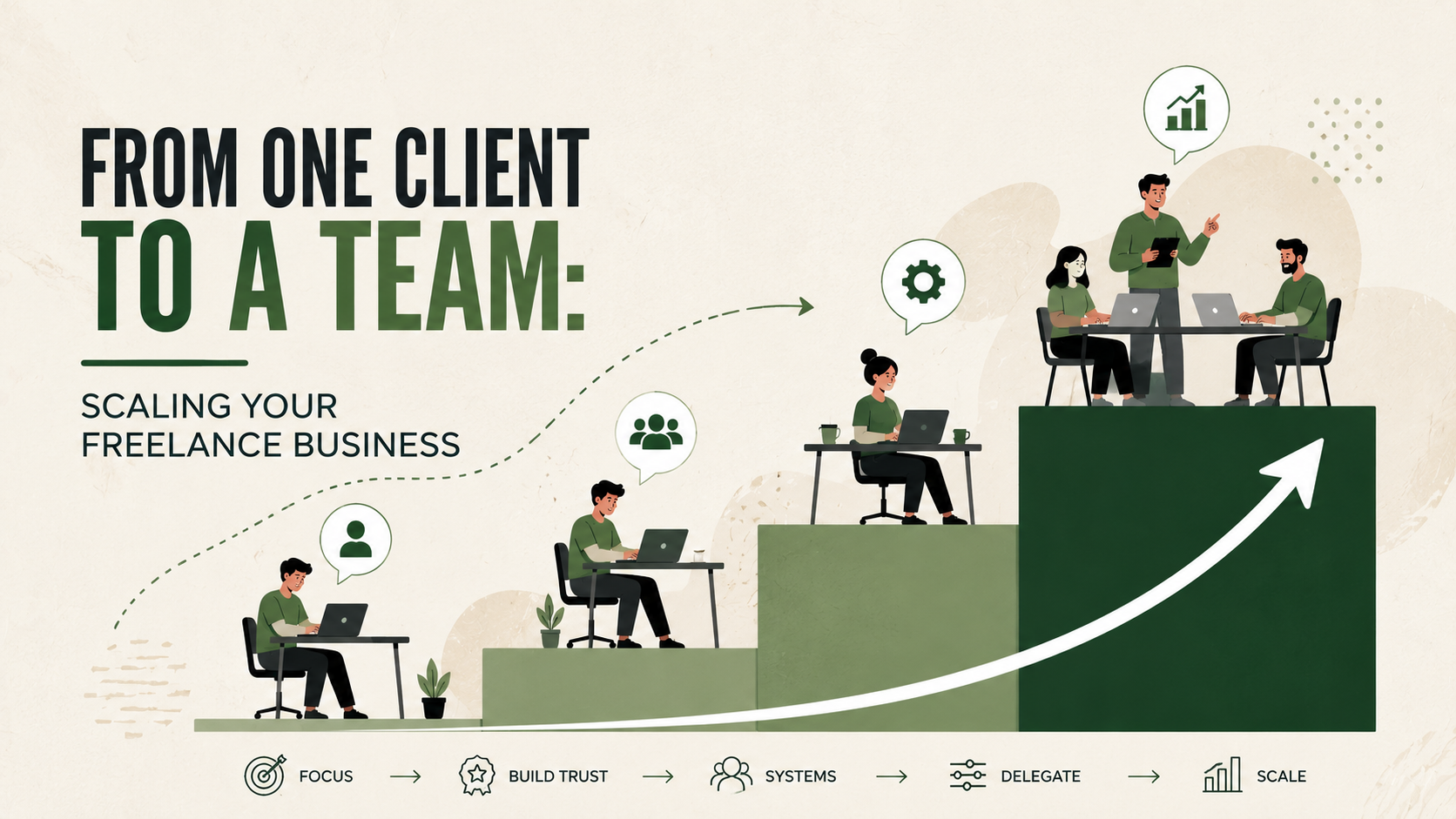
Freelancer growth usually hits a ceiling long before anyone talks about it openly. You get busy, then you get too busy, then every new client inquiry feels like a threat instead of an opportunity because there’s simply no more of you to go around. Scaling from a one-person operation into something closer to a small agency is one of the least discussed transitions in freelancing, mostly because most advice either stops at “get more clients” or jumps straight to “build an agency” without covering the messy middle part in between.
This is that middle part. It covers what actually changes when you go from doing every task yourself to handing pieces of it to other people, based on what freelancers who’ve made this jump report about the process, the mistakes, and what they’d do differently.
Scaling looks different for every freelancer, and there’s no single formula that works across every industry or personality type. But the freelancers who’ve actually gone through this transition, rather than just talking about wanting to, tend to describe a similar sequence of decisions, even when their businesses look nothing alike on the surface.
Why Most Freelancers Never Scale Past Solo
Plenty of people freelance for years without ever wanting to grow beyond themselves, and that’s a completely legitimate choice. But for the freelancer who does want to grow, the ceiling usually shows up the same way: you’re maxed out on hours, turning down work you’d normally take, and starting to notice quality slipping on rushed projects.
One freelancer writing candidly about this exact stage online described reaching a point where the workload became unsustainable, not because the business was failing, but because it was succeeding faster than one person could keep up with. That’s a strange problem to have, and it catches a lot of freelancers off guard because nobody warns you that too much demand can feel just as stressful as too little.
The instinct at this point is usually to just work harder or longer, and that works for a while. But a freelancer running at full capacity has no room left to handle emergencies, take a vacation, or say yes to the kind of bigger project that could meaningfully grow the business. Scaling isn’t really about greed or ambition for most people who go through it, it’s about removing the ceiling that comes from being a business of exactly one.
There’s also a quieter cost to staying maxed out indefinitely. Burnout tends to creep in slowly, and a freelancer who’s been running at one hundred percent capacity for months often doesn’t notice the decline in their own work until a client points it out. Scaling, done thoughtfully, is as much about protecting the quality that built the business as it is about growing revenue.
Get Honest About What’s Actually Eating Your Time
Before hiring anyone or handing off a single task, it helps to actually track where your hours go for a week or two. Most freelancers discover the split isn’t what they assumed. A significant chunk of time usually goes to things that have nothing to do with the actual skill someone is paying for: invoicing, scheduling, research, formatting, replying to routine emails, minor edits.
This matters because the first thing to hand off shouldn’t be your core craft, it should be the administrative weight around it. A freelancer who’s still doing their own invoicing and calendar management at scale is spending expensive hours on cheap tasks. Once you can see the breakdown clearly, the first hire practically picks itself.
- Track your hours for one or two representative weeks, not just a slow week.
- Separate tasks into “only I can do this” and “someone else could learn this.”
- Look specifically for repetitive tasks that eat time without needing your judgment.
Most people are surprised by how much of this list falls into the second category once they actually write it out. It’s easy to assume everything requires your personal touch when you’ve never had the option to hand any of it off before.
Hire for Leverage, Not for Comfort
The most common mistake freelancers make when scaling is hiring someone who does exactly what they do, at a lower rate, and expecting that to double output immediately. In reality, the first hire that creates real leverage is almost always someone who takes work off your plate that isn’t your highest-value skill, not someone competing directly in your specialty.
A designer scaling up often benefits more from hiring a project manager or a junior production assistant before hiring a second senior designer. A freelance writer often gets more relief from hiring an editor or a virtual assistant to handle client communication than from hiring another writer right away. The goal in the early stage isn’t replacing yourself, it’s freeing yourself up to do the parts of the job only you can do.
If you’re still deciding which parts of your own work to specialize in versus delegate, this guide is a useful reference for separating your core strengths from tasks that were only ever yours by default, not by necessity.
It’s worth revisiting this decision periodically rather than treating the first hire as permanent. As the business grows, the tasks worth delegating tend to shift, and a freelancer who keeps reassessing what actually needs their personal attention avoids getting stuck doing low-value work simply out of habit.
Start With Contractors, Not Employees
Almost every account of scaling successfully from solo freelancer to a small team starts the same way: bringing on other freelancers or contractors first, rather than full-time employees. This keeps costs flexible and avoids the legal and financial complexity of formal employment before you’re sure the extra revenue can support it.
A freelancer testing whether they can actually manage other people, something that’s a genuinely different skill from doing the work itself, benefits from a lower-stakes trial run. Hiring a contractor for a defined project or a set number of hours per week lets both sides evaluate the fit without either party committing to something bigger than they’re ready for.
This approach also mirrors how a lot of small agencies quietly operate behind the scenes. What looks like a five-person team on a website is sometimes one freelancer at the center coordinating four contractors, each handling a piece of the work, with client relationships still running through a single point of contact.
There’s also a tax and legal upside to starting this way. Contractors handle their own tax obligations and typically don’t require the same benefits, onboarding paperwork, or long-term commitment that employees do, which keeps overhead manageable while the business is still proving out whether the extra revenue justifies the extra structure. Many freelancers stay in this contractor-based model indefinitely, never converting to formal employment at all, simply because it continues to work well for their size and workflow.
Build Systems Before You Need Them
Handing off a task without a system attached to it usually creates more work, not less, because the freelancer ends up re-explaining the same thing repeatedly or fixing mistakes that a clear process would have prevented. Before delegating anything, it’s worth writing down exactly how you currently do that task, step by step, even if it feels tedious in the moment.
A simple written process, a template, a checklist, a short recorded walkthrough, turns a fuzzy expectation into something a new contractor can actually follow without guessing. This is also where a freelancer needs to get more comfortable with automation and shared tools, since a team scattered across time zones and platforms needs a central place to track projects, deadlines, and client communication.
If you’re building this kind of system for the first time, this setup covers how to structure client-facing materials in a way that stays consistent even when someone other than you is the one sending them.
Systems don’t need to be elaborate to be useful. A shared folder with clear naming conventions, a single project board everyone checks, and a short onboarding document for new contractors can cover most of what’s needed in the early stages. The goal is consistency, not complexity, and a freelancer who over-builds their systems before they’ve actually delegated anything often wastes time on infrastructure the business doesn’t need yet.
Protect the Client Relationship as You Delegate
Clients hired a specific freelancer, and a lot of them feel uneasy, whether they say so directly or not, when work starts getting quietly passed to people they’ve never spoken with. The freelancers who scale without damaging trust tend to be upfront about it rather than hiding the fact that a team is now involved.
Being direct about who’s doing what, and staying as the main point of contact even when someone else handles the execution, keeps the relationship intact. A client who understands they’re now working with a small team led by the freelancer they originally hired is usually fine with it, especially if quality stays consistent. A client who finds out by accident that their project was handled entirely by someone they’ve never heard of tends to feel misled, even if the final work was good.
A short note at the start of a project, mentioning that a specialist will be assisting on a specific piece of the work while you remain the main contact, usually settles any concern before it becomes one. Most clients care far more about the outcome and about knowing who to reach than about exactly how many people touched the project along the way.
Quality control matters just as much here. A freelancer who reviews every deliverable before it reaches the client, at least in the early stages of building a team, catches problems before they become a client-facing issue and protects the reputation that got the business this far in the first place.
Price for the Team, Not Just Your Own Hours
One of the more common financial mistakes at this stage is keeping rates exactly where they were as a solo freelancer while now paying contractors out of that same margin. Scaling only works financially if pricing accounts for management time, quality control, and the fact that a freelancer running a small team is now delivering more value than they were alone, not just more hours.
This often means renegotiating rates with long-standing clients or being more selective about which projects are worth taking on with a team involved versus handling solo. It’s an uncomfortable conversation for a lot of freelancers who built their business on being the affordable, scrappy option, but the pricing model that worked at one person doesn’t automatically work at three or four.
Some freelancers solve this by shifting toward value-based pricing rather than hourly rates as they scale, since it decouples what a client pays from exactly how many hours or which specific person did the work. Others simply build a clear internal margin into every quote from the start, so contractor costs are accounted for before a project is ever priced rather than eating into profit after the fact.
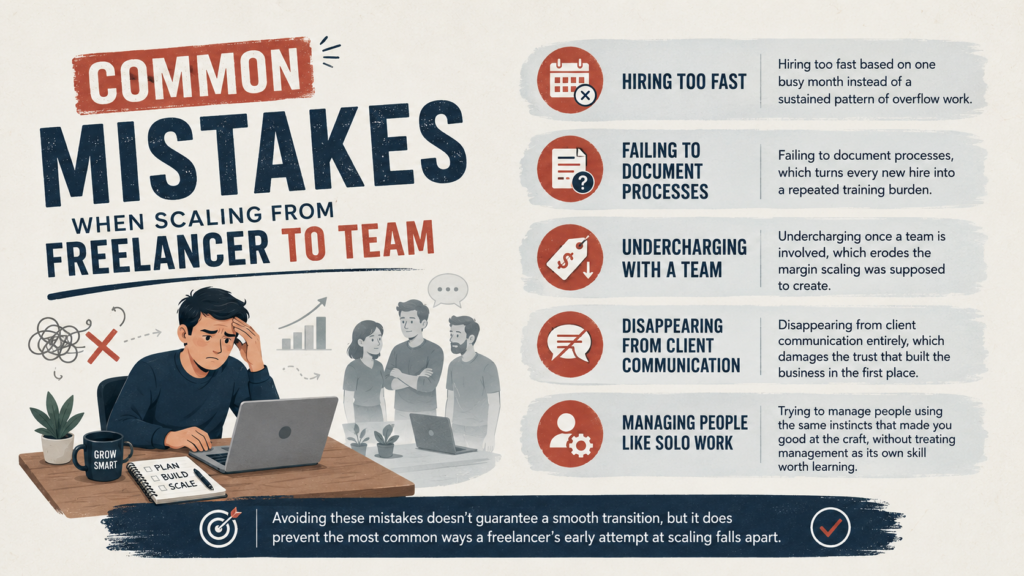
Common Mistakes When Scaling From Freelancer to Team
A few patterns show up repeatedly among freelancers who’ve tried to scale and hit friction along the way.
- Hiring too fast based on one busy month instead of a sustained pattern of overflow work.
- Failing to document processes, which turns every new hire into a repeated training burden.
- Undercharging once a team is involved, which erodes the margin scaling was supposed to create.
- Disappearing from client communication entirely, which damages the trust that built the business in the first place.
- Trying to manage people using the same instincts that made someone good at the craft itself, without treating management as its own skill worth learning.
Avoiding these mistakes doesn’t guarantee a smooth transition, but it does prevent the most common ways a freelancer’s early attempt at scaling falls apart.
When Scaling Isn’t the Right Move
Not every successful freelancer needs to build a team, and there’s no rule saying growth has to mean management. Plenty of freelancers deliberately choose to stay solo and instead scale through higher rates, better clients, or more efficient systems rather than adding people. That’s a legitimate strategy, not a failure to grow.
The freelancer who scales successfully tends to be someone who genuinely wants to manage people and build something bigger than their own output, not someone doing it because it seems like the expected next step. Scaling badly, chasing growth without wanting the responsibilities that come with it, tends to produce more stress than the ceiling it was meant to solve.
Making the Leap Without Losing What Made You Good
Going from one freelancer doing everything to a small team doing pieces of it is genuinely difficult, and almost everyone who’s done it describes some version of the same bumpy stretch: hiring the wrong person once, undercharging early on, spending more time managing than expected in the first few months.
None of that means it isn’t worth doing. A freelancer who scales thoughtfully, tracking where time actually goes, hiring for leverage instead of comfort, building real systems, and staying honest with clients along the way, ends up with something sturdier than a single person working at their absolute limit. The transition is uneven, but the ceiling that felt permanent when you were solo turns out to be exactly the kind of thing that moves once you stop trying to do it all yourself.
The freelancers who look back on this stretch tend to agree on one thing: it gets easier faster than expected once the first hire actually works out. The hardest part isn’t finding good people, it’s getting comfortable handing something off before you feel completely ready to.
