

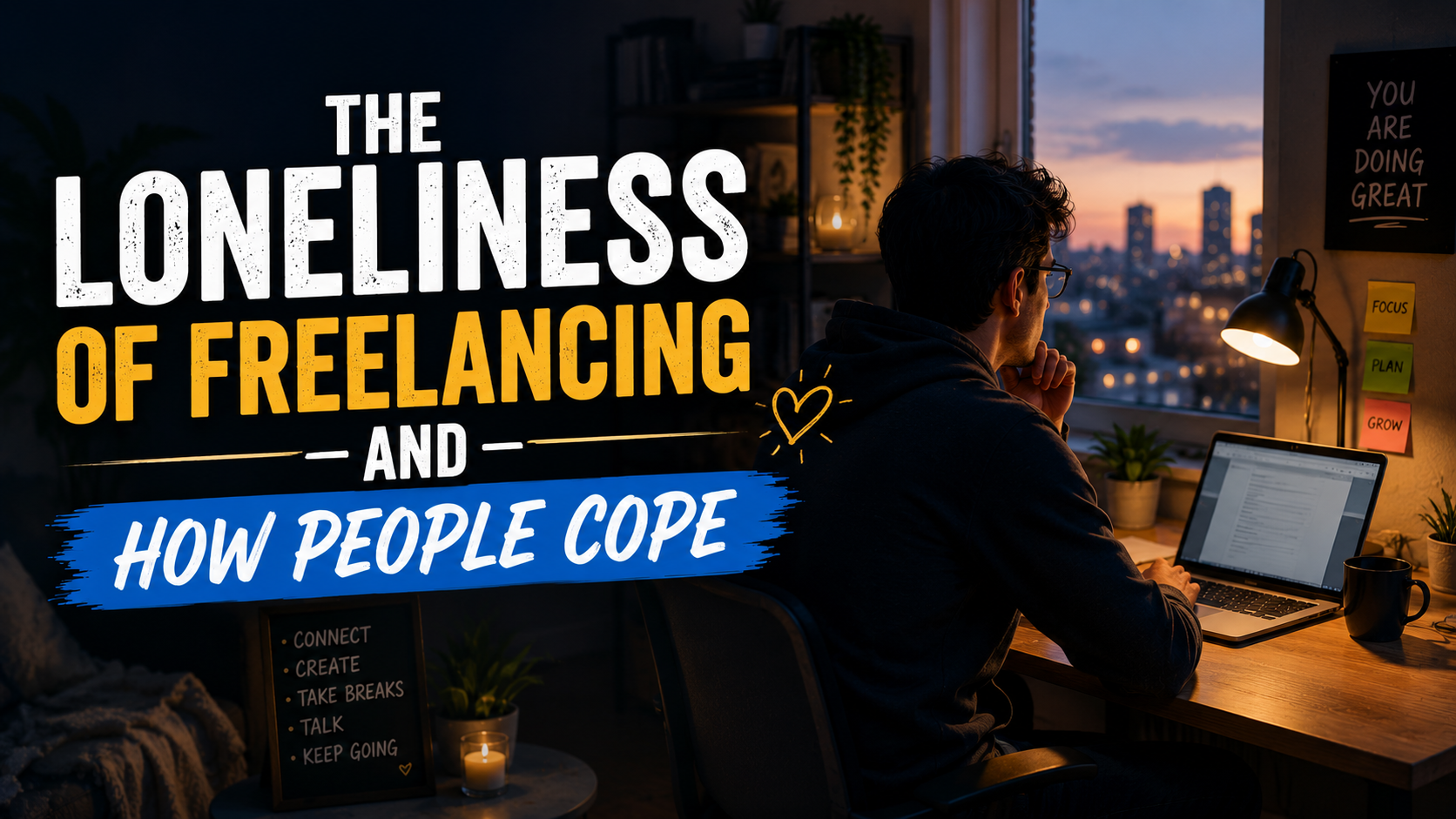
Freelancer life gets sold as the dream: no commute, no boss, no cubicle small talk you never asked for. What rarely makes the pitch is the quiet that shows up around week three, when the novelty wears off and you realize you have gone two days without talking to another human who isn’t a barista. Loneliness is one of the least discussed costs of working for yourself, and it deserves a straight answer instead of a highlight reel.
Why Freelancing Feels So Isolating
The isolation is not really about being alone in a room. Plenty of people work from home and feel fine. It is more about the absence of the small, unplanned social moments that an office quietly provides: someone stopping by your desk, a group lunch you didn’t have to organize, the five minutes of nonsense before a meeting starts. A freelancer builds an entire day around output, and there is no built-in mechanism that forces a conversation to happen.
One freelance photographer, writing about her first years working solo, put it simply: the excitement of the new setup wore off, and what was left was a growing sense of being alone, even though her calendar was full of client work. She noticed she’d sometimes go a week speaking mostly to the self checkout machine at the grocery store. That detail sticks because it is so ordinary. It’s not dramatic isolation, it’s the slow erosion of small daily contact most people don’t even register until it’s gone.
The strange part is that this can happen even to people who were never big on office culture to begin with. A person who hated small talk at the water cooler can still end up missing it once it’s gone, mostly because the absence of any small talk turns out to be its own kind of weight. Someone can be relieved to leave a stressful workplace and still, six months later, feel a version of grief for the low-effort human contact that came with it. Those two things are not a contradiction. They just describe how much of a person’s social life used to run on autopilot inside a job, without anyone planning it that way.
There is also a version of loneliness that shows up as a loss of feedback rather than a loss of company. In an office, someone tells you a project looks good, or points out a mistake, in real time. Working alone, that response often disappears or gets delayed by days inside a client’s inbox. Several freelancers writing about their own experience have described this less as classic loneliness and more as a kind of creative isolation, the sense of making things in a vacuum with no one nearby to react to them.
What the Numbers Say About Freelancer Loneliness
This isn’t just a feeling a handful of people have made up. Multiple surveys point in the same direction. A UK study by Epson found that 48% of freelancers described the work as lonely and 46% called it isolating, even though 54% also said it was liberating, which is a fair summary of how mixed the experience actually is. A separate Viking survey of 1,500 freelance and office workers found that 64% of freelancers said they felt lonely on a regular basis, and named it the single worst part of the job, ahead of income instability or long hours. Leapers, a UK-based support network for the self-employed, has stated that over 70% of freelancers report feeling lonely, disconnected, or isolated at some point in their working life.
Numbers like that make it clear this is not a personal failing. A freelancer who feels isolated is not doing something wrong; they are running into a structural gap in how solo work is set up.
What Freelancers on Reddit Say About Getting Lonely
A long-running thread on r/freelance asked a simple question: how do you deal with the loneliness of freelancing? The replies are a useful cross-section of what actually works day to day, as opposed to what sounds good in a listicle.
A recurring theme was leaving the house on purpose, not for errands but specifically to be around other people. Several commenters said they treat a coffee shop, library, or coworking desk as a second office, even a couple of times a week, just to sit near other humans while working. Others mentioned scheduling calls instead of emails whenever a project allowed it, because hearing another voice broke up the day in a way that Slack messages never did. A few people brought up joining online communities built around their specific craft (writers, designers, developers) rather than general freelancing groups, since the conversations there tend to be more substantive and less about logistics.
One thread that came up more than once: loneliness hits hardest for people who used to have a strong social life built entirely around a workplace, and who never replaced it with anything outside of work. The freelancers who seemed to struggle least were the ones who already had hobbies, sports leagues, or friend groups that had nothing to do with their job. Freelancing didn’t create their social life; it just stopped subsidizing one they hadn’t built for themselves.
Building a Routine That Actually Includes People
A freelancer without an office still needs some kind of external structure, or the days blur together. This does not mean copying a 9 to 5 schedule. It means deliberately putting human contact somewhere in the calendar, the same way you’d block time for invoicing.
That can be small. A standing weekly call with another freelancer just to compare notes on work. A regular gym class at the same time every week. A Tuesday coffee with a friend who also works from home. None of these need to be elaborate. The point is that they are fixed, so they survive a busy week instead of getting cut first when a deadline shows up.
Freelancers who avoid distractions and structure their day well tend to protect their social time too, since a workday that bleeds into the evening leaves nothing left for anyone else. Freelance Aura’s guide on how a freelancer can avoid distractions while working from home covers some of the practical habits that make this easier, from closing tabs to setting real stopping points.
Finding a Freelancer Community
Community is the word that comes up again and again in research on this topic, and for good reason. Fiverr Workspace’s own survey of independent workers found that 61% said a sense of community was missing from their freelance life, and 60% felt that freelancers were somewhat stigmatized compared to people in traditional jobs. That combination, missing community plus feeling slightly dismissed, is a fairly direct recipe for isolation.
The fix does not have to be complicated. Freelancers Union, Slack groups built around a specific skill, local meetups, and even informal group chats with two or three other independent workers all serve the same purpose: they give a solo worker somewhere to ask a dumb question, vent about a difficult client, or just be reminded that someone else is dealing with the same invoice headaches. A support network made of people in the same boat tends to help more than general encouragement from friends who have never freelanced, because they actually understand the specific weirdness of the job.
Freelance Aura’s collection of career-switch stories is a reminder that plenty of people have gone through this exact adjustment and found their footing, which can be oddly comforting on a bad week.
Coworking Spaces and Third Places
For a lot of people, a coworking space solves more of the loneliness problem than any app or online group ever could, simply because it puts other humans in the same physical room. It does not need to be a formal membership either. A café where the same regulars show up, a library with a decent desk setup, a shared studio with three other freelancers splitting the rent, all of these function as what sociologists call a “third place,” somewhere that is neither home nor a client’s office but still has a bit of social texture to it.
The freelancers who mentioned coworking in interviews and forum threads tended to describe the same benefit: it is not really about deep friendship, it is about ambient company. Working next to someone, even a stranger, changes the emotional tone of a day compared to an empty apartment. A freelancer does not need constant conversation, just the sense of not being the only person alive between 9am and 6pm.
Cost is the obvious objection, and a fair one. Formal coworking memberships add up, and not everyone’s income can absorb another monthly bill. That’s part of why the cheaper versions of this idea, a library desk, a regular café order, a rotating arrangement where a few independent workers share someone’s spare room once a week, get mentioned so often in freelancer discussions. The specific setup matters less than the habit of leaving the house and sitting near other people on purpose, rather than only when an errand forces it.
Timing helps too. Freelancers who pick a coworking day that lines up with something else social, a class beforehand, a friend who works nearby, tend to stick with it longer than the ones who treat it as one more isolated task on a to-do list. Stacking small social habits on top of each other seems to make each one easier to keep.
Setting Boundaries Between Work and Life
Loneliness gets worse when work has no edges. Viking’s research found that 60% of freelancers said their sleep was affected by work, compared to 40% of office employees, and that 85% never fully switch off, even on holiday. When work leaks into every hour, there is no space left to build the relationships that would otherwise counter the isolation.
Setting a real stopping point each day, and actually logging off instead of checking one more email, protects the hours a freelancer needs for anything social. It sounds almost too simple to matter, but the data backs it up: the freelancers who report the least loneliness are consistently the ones who treat their evenings and weekends as genuinely separate from the job, not just theoretically separate.
Part of the difficulty is that nobody enforces the boundary from the outside. An office has a closing time built in, even if people ignore it. Working for yourself, that closing time exists only if you decide it does and then actually hold to it, which is a different kind of discipline than getting the work done in the first place. A late-night email from a client does not need an answer at midnight just because it arrived then. Letting it sit until morning, most of the time, costs nothing but a few hours, and buys back an evening that would otherwise disappear into low-grade work anxiety instead of being spent with anyone.
When Loneliness Becomes Something More
There is a difference between the ordinary loneliness of a quiet Tuesday and something heavier. Epson’s UK survey found that 25% of freelancers had experienced frequent periods of depression, and around 21% reported that isolation had led to suicidal thoughts. Those figures are hard to read, but they matter, because they show that freelancer loneliness is not always a minor inconvenience that solves itself with a coffee shop membership.
If the isolation stops feeling like background noise and starts affecting sleep, appetite, or motivation for weeks at a time, that is a signal to bring in more support than a networking group can offer, whether that is a therapist, a doctor, or a mental health charity. Organizations like Mind in the UK and similar services elsewhere exist specifically because this problem is common enough to need dedicated support, not because anyone asking for help is doing freelancing wrong.
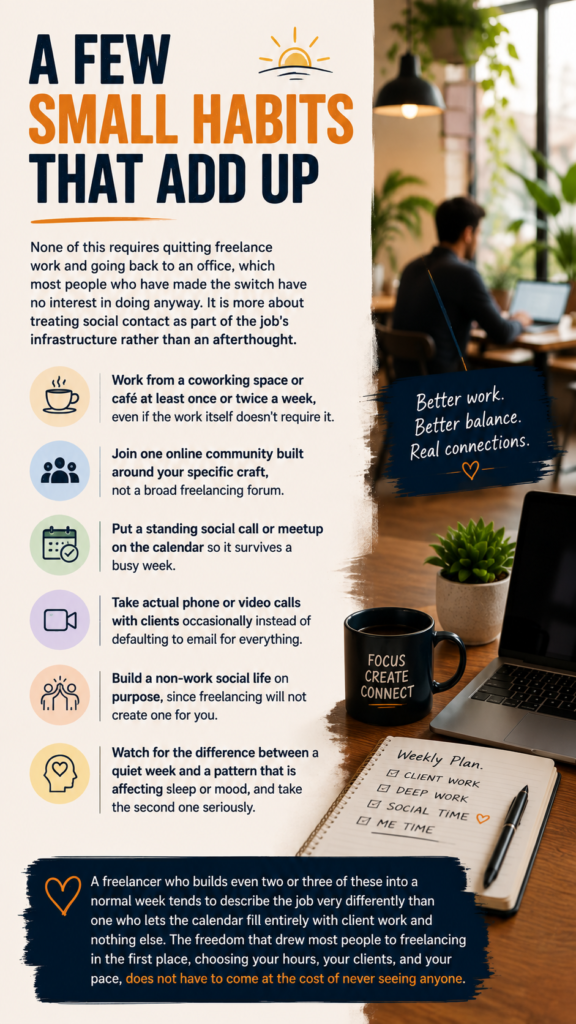
A Few Small Habits That Add Up
None of this requires quitting freelance work and going back to an office, which most people who have made the switch have no interest in doing anyway. It is more about treating social contact as part of the job’s infrastructure rather than an afterthought.
A few things worth trying, based on what actually shows up in freelancer accounts and research rather than generic advice:
- Work from a coworking space or café at least once or twice a week, even if the work itself doesn’t require it.
- Join one online community built around your specific craft, not a broad freelancing forum.
- Put a standing social call or meetup on the calendar so it survives a busy week.
- Take actual phone or video calls with clients occasionally instead of defaulting to email for everything.
- Build a non-work social life on purpose, since freelancing will not create one for you.
- Watch for the difference between a quiet week and a pattern that is affecting sleep or mood, and take the second one seriously.
A freelancer who builds even two or three of these into a normal week tends to describe the job very differently than one who lets the calendar fill entirely with client work and nothing else. The freedom that drew most people to freelancing in the first place, choosing your hours, your clients, and your pace, does not have to come at the cost of never seeing anyone.
The Bottom Line
Loneliness is one of the most consistently reported downsides of freelance work, and the surveys back up what shows up in forum threads and personal essays alike: a large share of freelancers deal with it at some point, and a smaller but real share deal with something more serious. None of that means freelancing is a bad choice. It means the social side of the job needs the same amount of planning as the financial side does. A freelancer who treats human contact as a line item, not an accident, tends to hold onto both the independence and the connection that make the work worth doing in the first place.
