

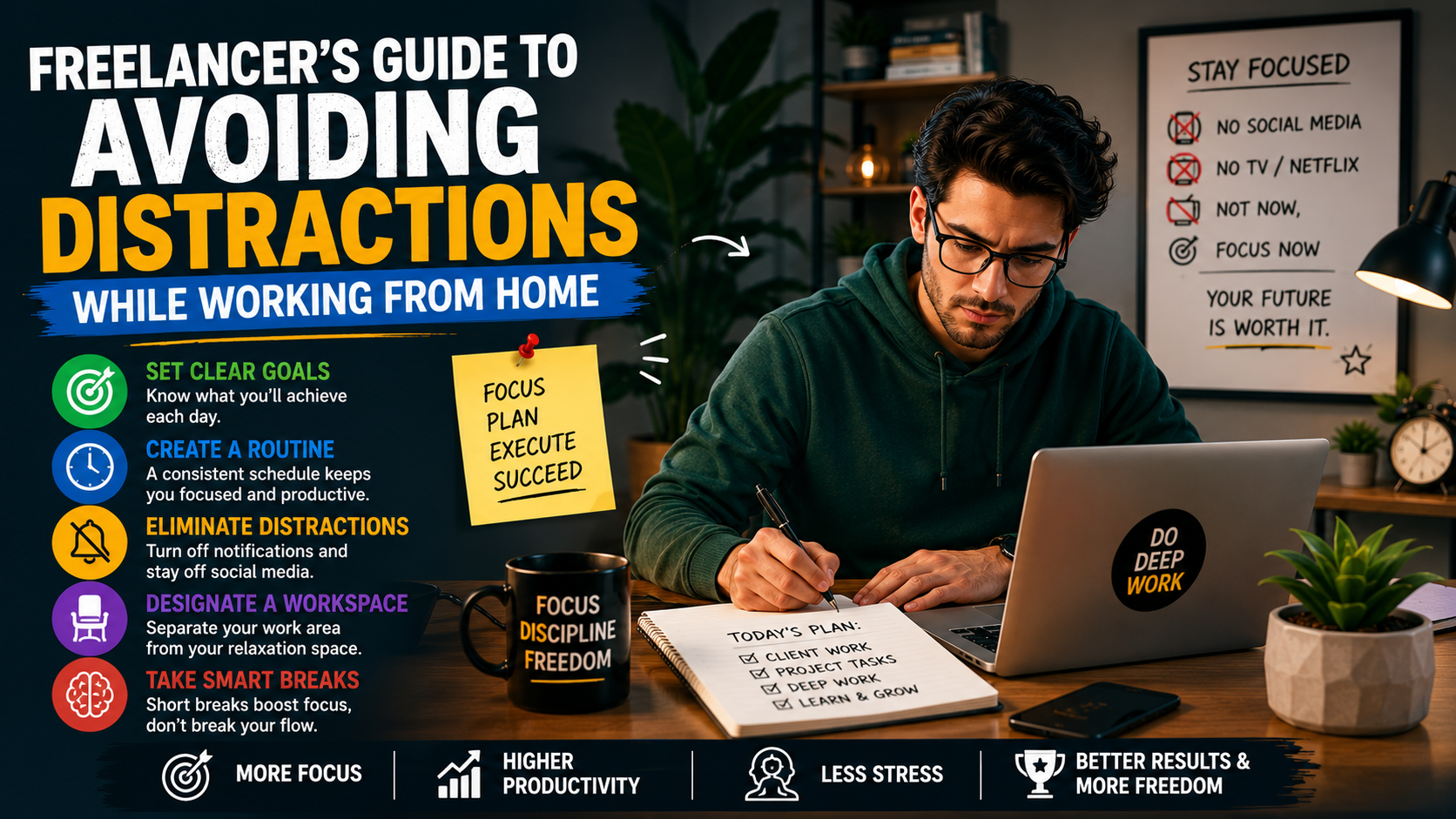
Every freelancer who’s ever worked from a kitchen table knows the exact moment it happens: you sit down to start a task, and somehow forty minutes later you’re reorganizing a cupboard that was fine yesterday.
Nobody’s standing over your shoulder when you work from home. That’s the whole appeal. It’s also exactly why distraction is so much easier to fall into than most freelancers expect before they actually try it.
The good news is that this isn’t a willpower problem you’re uniquely bad at. It’s a structural one, and structural problems respond to systems, not guilt. Below are nine practical, tested ways to stay focused, based on real freelancer advice and what the research on remote work actually shows.
Why This Hits Freelancers Differently Than Remote Employees
A remote employee still has meetings, a manager checking in, and colleagues who notice if a Slack message goes unanswered for two hours. A freelancer usually doesn’t have any of that. There’s no one else clocking whether the work got done today or tomorrow, which means the only accountability in the room is the one you build for yourself.
The research on remote work productivity is genuinely mixed on this point, and it’s worth being honest about both sides. A number of large studies have found that remote workers report meaningfully higher productivity than in-office staff, driven mostly by fewer interruptions and more control over the workday. One widely cited figure puts that gain at roughly 35 to 40 percent. At the same time, other surveys found a very different result for younger or newer remote workers specifically, with some reporting decreased output once the structure of an office disappeared entirely.
Put simply: working from home can make you either far more productive or noticeably less productive, and the difference usually comes down to whether you’ve built any structure around your day at all.
For a freelancer specifically, the stakes are higher than they are for a remote employee with a salary that arrives regardless of how the week went. A freelancer’s income is tied directly to hours actually spent producing work clients will pay for, which means a distracted week doesn’t just feel unproductive, it shows up on the bank statement a few weeks later.
1. Learn When You’re Actually Sharp, and Protect That Window
Not every hour of the day is equal. Some freelancers do their best writing at 6 a.m. before anyone else is awake. Others don’t hit their stride until well after lunch. The mistake is ignoring your own pattern and forcing deep, difficult work into a time slot where your brain simply isn’t cooperating yet.
Pay attention for a week to when you’re naturally most focused, then protect that window specifically for the task that needs the most concentration, whether that’s a first draft, a design concept, or a piece of code that actually requires thinking rather than just typing.
2. Break Big Projects Into Small Wins You Can Actually Feel
A project that’s due in two weeks doesn’t feel urgent on day one, which is exactly the problem. The brain struggles to get motivated by a deadline that’s still far away, but it responds well to small, immediate markers of progress.
Splitting a large project into smaller milestones, and building in a small reward each time one gets finished, whether that’s a coffee break, twenty minutes outside, or simply crossing something off a list, keeps momentum going in a way a single distant deadline never will.
3. Know Your Own Freelancer Distractions, and Remove Them Before You Start
Every freelancer has a specific weak point, and it’s rarely a mystery. For some people it’s checking email the second a notification pops up. For others it’s a phone buzzing on the desk, or a browser tab that quietly opens “just to check one thing” and turns into forty-five minutes of nothing.
The fix isn’t more discipline in the moment. It’s removing the temptation before it exists: turning off email notifications during a deadline push, putting the phone on silent in another room, and closing every browser tab that isn’t directly needed for the task in front of you.
4. Work on One Thing at a Time
Multitasking feels productive in the moment, and for a freelancer juggling multiple clients, it rarely is. Keeping five tabs, two documents, and a chat window open at once means your attention is constantly splitting instead of building on itself.
Open only what the current task requires. Everything else, the second inbox tab, the reference document you might need later, the app you’re only half using, can wait until the task in front of you is actually finished.
5. Remember That Every Distracted Hour Costs a Freelancer Money
For a salaried employee, a slow afternoon doesn’t show up anywhere obvious. For a freelancer, it does, directly, in the form of a later invoice and a delayed next project. That connection between focus and income is one of the most useful motivators available, precisely because it’s real rather than abstract.
The faster a task gets finished, the sooner it gets invoiced, and the sooner the next paying project can start. Framing distraction as literal lost income, not just lost time, tends to land harder than any generic productivity advice.
6. Start the Day Before the Excuses Wake Up
Waking up with real pressure already on the clock, rather than a loose “I’ll get to it sometime today,” changes how the whole morning goes. Setting an alarm an hour earlier than usual on a genuinely tight deadline day can turn a sluggish start into a focused sprint, simply because there’s less room left for the day to drift.
7. Start With the Easy Part, Not the Hard Part
Staring at a blank page waiting for motivation to strike rarely works. A more reliable approach is starting with whatever part of the project already has a clear, obvious answer, then building momentum toward the harder, more ambiguous sections once you’re already in motion.
Warm up with the easy wins first. It beats sharpening pencils, tidying a desk, or any of the other small rituals that feel like preparation but are really just delay.
8. Put the Plan in Writing, and Share It With the Client
A schedule that lives only in your head is easy to quietly abandon. A schedule that’s been sent to a client, broken into visible stages with dates attached, is much harder to let slide, because someone else is now expecting to see that progress.
This does double duty. It builds in real accountability, and it gives the client visibility into the project without them having to ask for a status update, which tends to build trust on its own.
9. When Focus Won’t Come, Step Away Instead of Forcing It
Sometimes the problem isn’t organization at all, it’s simply mental fatigue, and pushing harder against it doesn’t help. A short walk outside, away from every screen in the house, is one of the more consistently recommended resets for freelancers who feel stuck. It’s not a productivity hack so much as it is basic recovery, and it usually works better than another twenty minutes of unfocused scrolling disguised as a break.

Common Distraction Traps That Hit Freelancers Specifically
Not every distraction affects a freelancer the same way it affects a remote employee. A few traps show up again and again in freelancer routines specifically, and they’re worth naming individually.
Household chores disguised as productivity. Laundry, dishes, a “quick” grocery run, none of these feel like slacking off in the moment, because you’re still technically getting something done. But they’re still avoidance, just dressed up as responsibility. If a chore isn’t urgent, it can wait until the work session ends.
Isolation that turns into overcommunication. Working alone all day gets lonely fast, and it’s tempting to fill that gap by checking Slack, email, or social media constantly, partly for the work itself and partly just for human contact. The fix isn’t cutting off contact entirely, it’s scheduling specific check-in windows instead of reacting to every notification the moment it appears.
Family, roommates, and pets who don’t know you’re “at work.” A closed office door means something in a traditional workplace. At home, it often doesn’t, unless you actively set that expectation. A short conversation about which hours are off-limits, or a simple visual signal like a closed door or a sign, does more than most freelancers expect to cut down on mid-task interruptions.
The blurred line between “done for the day” and “still working.” Without a commute or an office to physically leave, plenty of freelancers drift into checking email late at night, which paradoxically makes daytime focus worse, since the brain never gets a real signal that the workday actually ended.
Tools That Help a Freelancer Remove the Temptation, Not Fight It
Willpower is a limited resource, which is exactly why the most effective fixes tend to remove temptation entirely rather than relying on resisting it in the moment.
- Website and app blockers (like Freedom or Cold Turkey) that lock you out of specific sites during a set focus window, so the decision to avoid them isn’t something you have to keep making manually every few minutes.
- A simple visual timer using something like the Pomodoro technique, 25 minutes of focused work followed by a short break, gives distraction a scheduled outlet instead of letting it interrupt whenever it wants.
- Phone-free zones, even just leaving the phone in another room during a deep-focus block, remove the single biggest source of reflexive checking most people deal with during the day.
- A dedicated workspace, even a small desk in the corner of a room rather than the couch or the bed, helps the brain associate a specific physical spot with focused work, which makes it easier to drop into that mode each time you sit down there.
What the Data Says About Freelancer Focus at Home
It’s worth zooming out from individual tactics for a moment, because the broader research backs up why this topic matters so much for anyone working outside a traditional office.
- Roughly 70% of remote workers report that focused work is genuinely easier at home than it was in an office, largely due to fewer interruptions and more control over their environment.
- About half of remote workers say avoiding distractions specifically is easier when working remotely, according to a widely cited Buffer survey, though the other half clearly still struggle with it.
- Commuting time that disappears with remote work, an average of well over an hour a day for many workers, gets redirected in part toward actual work, and in part toward rest, both of which support sustained focus rather than burnout.
The takeaway from the data isn’t that working from home automatically fixes focus. It’s that home removes a specific category of interruption (office noise, meetings, drop-bys) while introducing a completely different category (laundry, pets, a much shorter walk to the fridge). Managing the second category well is what actually determines whether the switch to home-based work becomes a net gain or a net loss.
Turning Focus Into a System a Freelancer Can Actually Follow
None of these nine ideas require expensive tools or a total personality overhaul. What they have in common is that they turn focus into a system rather than something a freelancer has to white-knuckle their way through every single morning.
A useful next step is pairing these habits with the tools that already structure your workday. If your task list lives in a proper project tracker instead of scattered sticky notes, distractions have less room to creep in simply because there’s less ambiguity about what you’re supposed to be doing right now.
Our breakdown of tools built specifically for solo freelancers is a good place to start if your current system is still a mix of memory and half-finished notes.
And once the workday itself is under control, it’s worth applying the same structure to the client-facing side of the business too, since a focused workday doesn’t mean much if the invoice at the end of it takes two months to arrive.
For more grounded, low-effort tips along these same lines, Free-Work’s short guide on avoiding distractions while working from home is worth a quick read as well.
How a Freelancer Knows the System Is Actually Working
It’s easy to add habits and never check whether they’re helping. A freelancer who wants to know if these changes are actually paying off doesn’t need complicated tracking software, just a few honest signals checked at the end of each week.
- Are deadlines getting hit with less last-minute scrambling than a month ago?
- Is the time between “I finished the work” and “I sent the invoice” shrinking?
- Are fewer workdays ending with the feeling that you were busy all day but somehow got very little done?
If the answer to those is trending in the right direction, the system is working, even if it doesn’t feel dramatic day to day. Focus rarely improves in one obvious leap. It shows up gradually, in slightly calmer weeks and slightly fewer late nights spent catching up on work that distraction pushed aside earlier.
The Bottom Line
Distraction isn’t a character flaw unique to people who work from home. It’s the predictable result of removing external structure and not replacing it with anything of your own.
The freelancers who stay focused long-term aren’t the ones with superhuman willpower. They’re the ones who noticed their own weak points early and built small, specific habits around them, one alarm, one closed tab, one shared schedule at a time.
Start with one or two of the ideas above rather than all nine at once. The goal isn’t a perfect system on day one. It’s a workday that gets a little more focused every week than it was the week before.
