

The first year of freelancing rarely looks like the photos of laptops on beaches. It looks more like refreshing your inbox, rewriting your profile for the fourth time, and celebrating a $150 project as if it were a promotion.
That’s not a complaint. It’s simply what the start of almost every independent career looks like, and knowing it in advance makes the hard months much easier to sit through.
This guide walks through the year roughly as it tends to unfold: the slow start, the first real clients, the money swings, the routines, and the mistakes that cost new freelancers the most. Where we use numbers, they come from published research. Where we give examples, they’re illustrations, not stories about real people.
Why the First Year of Freelancing Feels So Different
A job hands you structure. Someone else finds the customers, sets the hours, sends the paycheck, and handles the taxes. When you leave that behind, you suddenly own every one of those tasks at once.
That’s why the first year of freelancing often feels harder than the work itself. You’re learning a business, not just a skill. Sales, pricing, bookkeeping, contracts, and self-discipline all land on your desk in the same month.
You’re also not alone in trying it. The Upwork Research Institute’s 2025 study of U.S. skilled knowledge workers found that 28% of them, more than 20 million people, freelance or work independently. Plenty of people have walked this path before you.
Your First Year of Freelancing, Month by Month
No two freelancers move at the same pace, but the shape of the year is surprisingly common. Treat the stages below as a rough map, not a schedule.
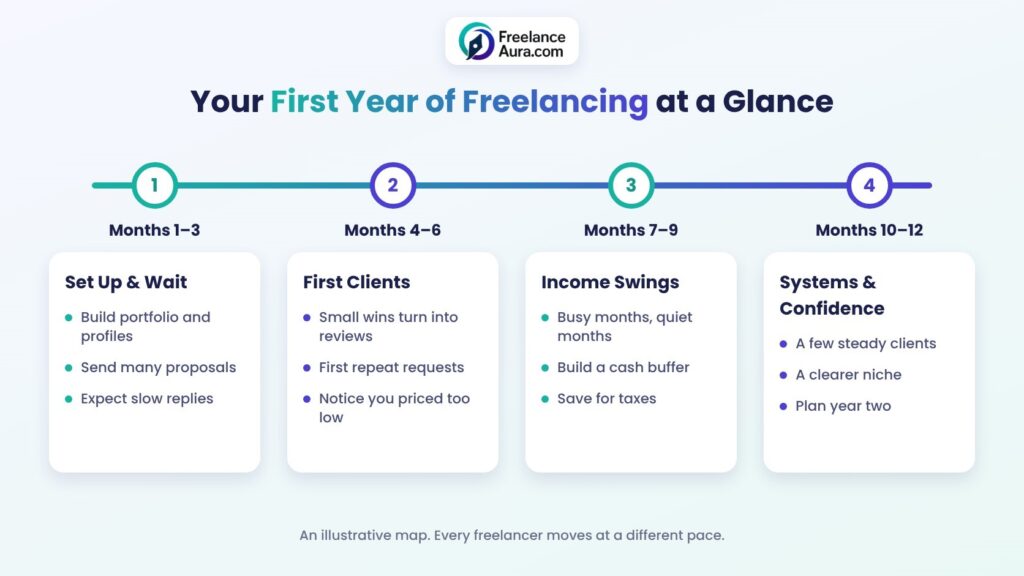
Alt text: First year of freelancing timeline showing four stages from months 1 to 12
Months 1–3: Setting Up and Waiting
The early weeks of your first year of freelancing are mostly setup. You build a portfolio, write your profiles, decide on prices, and send far more proposals than you expected to.
Replies are slow. Many new freelancers hear nothing back from most of their pitches, which feels personal but usually isn’t. Clients choose people with reviews and samples, and you don’t have many yet.
The best use of this stage is to make your work easy to judge. Our guide to building a freelance portfolio that wins first clients covers what to put in it when you’re starting from almost nothing.
Months 4–6: First Clients and First Reviews
Somewhere in the first year of freelancing, usually around this point, things start to move. A small project turns into a good review. One happy client asks for a second job. You stop guessing what clients want because you’ve now heard it directly.
This is also when many freelancers notice they priced too low. That’s normal. Early rates are often set out of fear, and they can be raised once you have proof that your work delivers.
Months 7–9: The Income Rollercoaster
By the middle of the first year of freelancing, money starts coming in, but rarely in a straight line. A great month might be followed by a quiet one, simply because two projects ended at once.
For example, a designer might earn twice their old salary in one month and almost nothing the next. Both months are part of the same business. The trick is to stop judging success month by month and start looking at a rolling three-month average.
Months 10–12: Systems and Confidence
Toward the end of the first year of freelancing, most people have a few repeat clients, a clearer niche, and a rough idea of what a “normal” month looks like. Work stops feeling like a scramble and starts feeling like a business.
This is the right time to look back. Which clients were profitable? Which ones drained you? What kind of work do you want more of in year two?
Money Lessons From the First Year of Freelancing
Money is where most new freelancers get caught off guard. Not because they earn too little, but because nobody taught them how irregular income behaves.
A few habits make the biggest difference:
- Build a buffer. Many experienced freelancers aim to keep several months of expenses saved, so a slow month is an inconvenience rather than a crisis.
- Pay yourself a fixed amount. Move business income into a separate account, then pay yourself the same sum each month, like a salary.
- Set aside money for taxes from day one. No employer is withholding anything for you anymore.
- Track every expense. Software, equipment, and internet costs add up, and in many countries some of them may reduce your tax bill.
Taxes deserve a special warning, because they surprise many people in their first year of freelancing. In the United States, the IRS self-employed individuals tax center explains that you generally must file a return if your net self-employment earnings are $400 or more, and that self-employed people usually pay estimated tax during the year. Rules differ by country, so check your local tax authority or a qualified accountant.
The good news is that freelancing can pay well once it settles. In the same Upwork study, the median income of people earning only from freelance work was $85,000, compared with $80,000 for full-time employees in that survey. That’s a median for skilled U.S. knowledge workers, though, not a promise for year one.
Finding Clients: What Actually Works Early On
In the first year of freelancing, you’re rarely short on skill. You’re short on trust. Clients can’t see inside your head, so everything you do should make it easier for them to believe you’ll deliver.
What tends to work best early:
- Your existing network. Former colleagues, managers, and friends often become the first clients, because they already trust you.
- Narrow offers. “I design landing pages for dentists” is easier to buy than “I do design.”
- Fast, specific proposals. Answer the client’s actual problem in the first two lines.
- Asking happy clients for referrals. One satisfied client can lead to two more.
Freelance platforms can help too, but they reward patience. Expect to send many proposals before you win the reviews that make the next jobs easier.
Routines That Keep You Sane
Without a manager or an office, a day in your first year of freelancing has no edges unless you create them. Early on, that freedom can turn into working until midnight or not starting until noon.
Simple routines fix most of it. Start at the same time each day. Plan your top three tasks the night before. Set a clear end time, even if it’s loose at first.
You don’t need a perfect system. If you want ideas, these freelancer morning routines with real examples are a good place to borrow from.
It also helps to plan for the emotional side of the first year of freelancing. Working alone can feel isolating, especially after years in a busy office. Our article on how freelancers cope with loneliness shares practical ways people stay connected.
7 Mistakes That Derail the First Year of Freelancing
Most first-year problems trace back to a short list of mistakes. Avoiding even a few of them saves months of stress.
1. Saying yes to every project. Bad-fit clients take more time and pay less.
2. Working without a contract. Even a simple written agreement prevents most disputes.
3. Pricing by fear. Low rates attract demanding clients and are hard to raise later.
4. Skipping the tax savings. A large bill at year end can wipe out months of progress.
5. Relying on one client. If they leave, your whole income leaves with them.
6. Never taking time off. Exhaustion creeps up slowly, then all at once.
7. Comparing yourself to people in year five. Their highlight reel isn’t your starting line.
That sixth point matters more than it looks. Many new freelancers push hard for months, then crash. These stories of freelancers overcoming burnout show what it looks like and how people recovered.
Milestones Worth Celebrating
Progress in the first year of freelancing is easy to miss, because there’s no performance review to point it out. So mark the wins yourself:
- Your first paid project, however small.
- Your first five-star review.
- Your first repeat client.
- The first month you covered all your bills.
- The first time you turned down work that wasn’t right for you.
That last one is a quiet sign of growth. It means you’re choosing your business instead of just reacting to it.
Is It Worth It?
Research suggests many people who try independent work want to keep going. MBO Partners’ State of Independence research reports that 78% of independent professionals plan to keep working independently or build a larger business. The Upwork study found that only 10% of freelancers wanted to return to traditional employment.
Those numbers don’t mean freelancing suits everyone. Some people find they miss the stability, the team, or the clear career ladder of a job, and that’s a perfectly valid conclusion. The point of the first year of freelancing is partly to find out which camp you’re in.
If you’re still deciding whether to make the jump, these real 9-to-5 to freelancer career-switch stories are worth reading first.
Final Thoughts
Your first year won’t be smooth, and it isn’t supposed to be. It’s the year you build the basics: a portfolio, a client list, a money system, and a daily rhythm that works for you.
Give yourself credit for every small step. Most people who reach a comfortable year three got there by surviving a messy first year of freelancing, not by skipping it.
Want more real-world guidance? Browse the full Freelancer Lifestyle & Success Stories category, or see how others make it work while still in school in our guide to freelancing as a student.
