

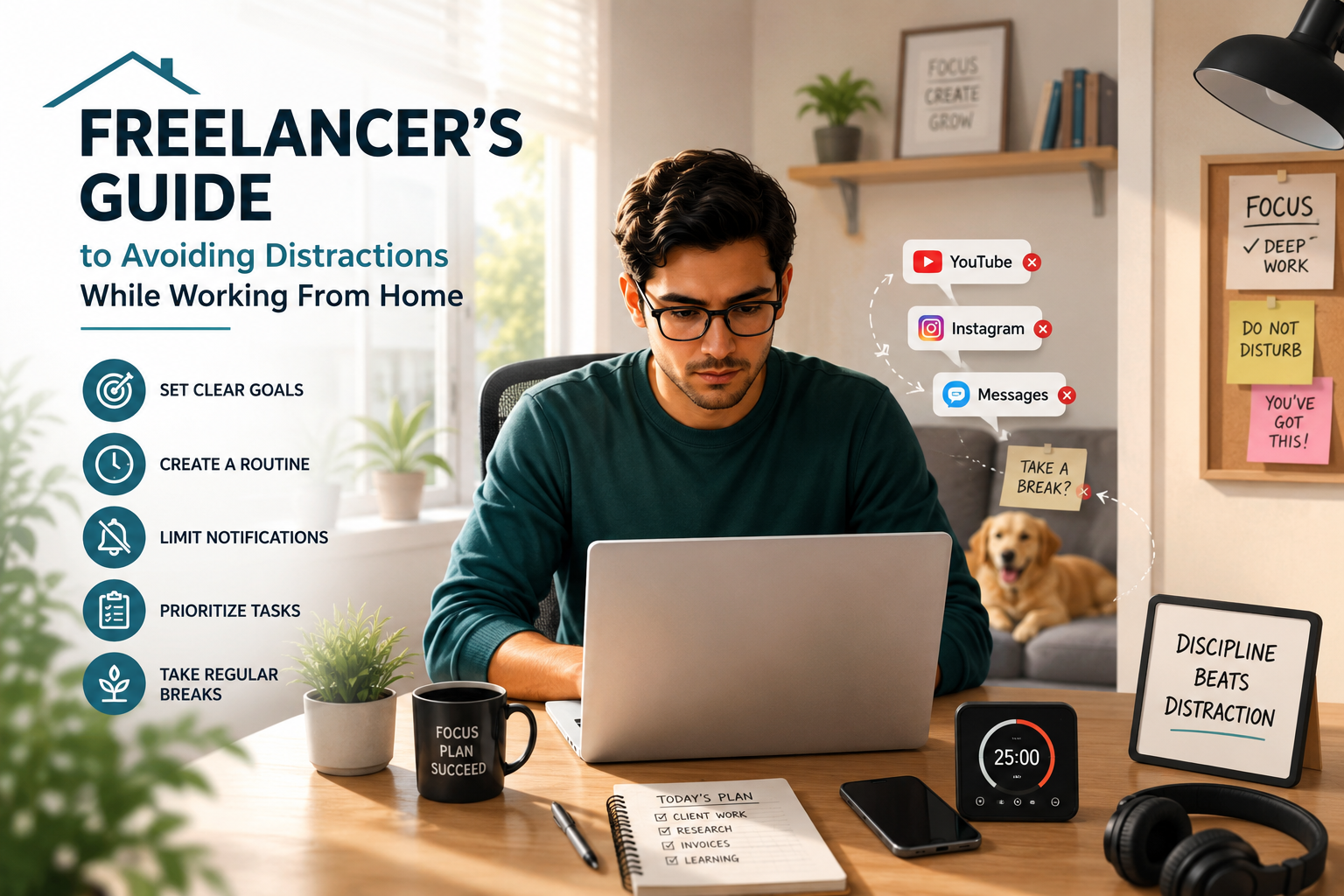
Freelancer life sounds simple on paper: no commute, no office chatter, no one hovering over your shoulder. Then the dishwasher finishes, a delivery truck idles outside, and your phone lights up with a group chat you swore you’d mute. Working from home hands you freedom and a minefield of small interruptions in the same breath, and most people who try it for the first time underestimate how much that freedom costs in focus.
The good news is that distraction isn’t a personal failing, and it isn’t something only disorganized people struggle with. It’s a design problem. Your home was built for living in, not for producing billable hours, so it makes sense it keeps pulling your attention away from the screen. Below are nine habits that experienced freelancers actually rely on, drawn from productivity writers, freelance forums, and the everyday advice that keeps circulating because it holds up.
Why a Freelancer’s Home Office Fights Back
An office comes with built-in social pressure. Someone might walk past your desk, a manager might ask for a status update, and the building itself is designed for one purpose. A freelancer’s home has none of that. It’s full of competing signals: the couch says rest, the kitchen says eat, the pile of laundry says deal with me. None of it is loud on its own, but stacked together across a workday, it adds up to a lot of small tugs on your attention.
There’s also no natural stopping point. In an office, the day ends when you leave the building. At home, work and everything else share the same four walls, which is a big part of why distraction and burnout tend to show up together for people who freelance long-term.
A survey of remote workers found that people run into roughly sixty separate interruptions across an average workday, and researchers have put the broader cost of workplace interruptions in the hundreds of billions of dollars a year. Not every one of those interruptions is dramatic. Most are small: a notification, a noise from another room, a thought about something unrelated that pops up and derails the current task. The problem isn’t any single distraction. It’s the sheer volume of them competing for a limited amount of attention.
It also helps to separate two different problems that get lumped together. One is external distraction, things happening around you that pull your eyes off the screen. The other is internal, the wandering mind that shows up even in total silence. Most advice focuses on the first because it’s easier to fix, but a freelancer who struggles to concentrate even with the phone off and the door closed is usually dealing with the second, and that calls for a different kind of solution, like shorter work sessions or a change of task rather than a change of environment.
Set Up a Workspace That Isn’t Also Your Couch
You don’t need a spare room to make this work. Plenty of freelancers write, design, and code from a corner of a bedroom or a kitchen table. What matters is that the spot gets used for work and, ideally, nothing else. Sitting in the same chair where you watch TV at night trains your brain to treat the two activities as interchangeable, which makes it harder to stay locked in once you sit down.
If a separate desk isn’t realistic, small cues still help: a mug you only use while working, headphones that go on only during focus time, a lamp you switch on to mark the start of the day. These little rituals do more than they get credit for. They tell your brain a work session has started before you’ve typed a single word.
Lighting and noise matter more than most people expect too. A dim corner makes it easier to slip into low-energy mode, and background television, even muted, tends to steal more attention than people realize because the brain keeps checking for movement on screen. Natural light and a bit of consistent, non-verbal background noise, a fan, quiet instrumental music, or a white noise track, tend to work better for sustained focus than silence or a talk-heavy podcast.
One more thing worth doing: keep the workspace tidy at the end of each day, even a rough tidy. Walking into a cluttered desk in the morning adds a small mental tax before the workday has even started. A freelancer who spends two minutes clearing the desk the night before tends to sit down and start faster the next morning, because there’s nothing left to sort through first.
Guard Your Freelancer Calendar Like You’d Guard an Invoice
Every freelancer knows what it feels like to chase a late payment. Treat your work hours with that same seriousness. Block time on your calendar for focused work and protect it the way you’d protect money owed to you. If a friend suggests a midday coffee, that’s a request against your schedule, not a favor you owe just because you happen to be home.
Sharing a rough schedule with clients works in your favor too. When a client knows you’re heads-down until 2 p.m., they stop expecting instant replies, and you stop feeling guilty about not checking email every ten minutes. A schedule you’ve written down and shared with someone else is much harder to abandon than one that only lives in your head.
Try scheduling around your own energy rather than a generic nine-to-five. Some people write their best copy at eleven at night, others do their sharpest editing right after waking up. There’s nothing wrong with a workday that starts at 10 a.m. or one that has a long break in the middle for errands, as long as the hours you do commit to are treated as fixed. The flexibility that draws people to freelancing in the first place only pays off if it’s paired with enough structure to actually get the work done.
Turn Off Notifications Before They Turn You Off Task
Email, texts, and social apps are built to interrupt you, and they’re very good at their job. If you’re facing a deadline, close your email client entirely instead of leaving it open in a background tab. Put your phone on silent, or better, in another room. Knowing a message arrived ten minutes ago and not checking it is its own kind of distraction, so the simplest fix is never seeing it happen in real time.
The same goes for browser tabs. If you catch yourself wondering whether it’s worth checking a shopping site or your feed, that’s usually the moment to close the tab, not open it. A freelancer who keeps only the one application needed for the current task tends to finish faster, simply because nothing else is competing for attention.
Browser extensions that block specific sites during set hours can help if willpower alone isn’t cutting it. They’re not a magic fix, and plenty of freelancers simply disable them the moment they’re determined to get distracted, but the extra step of turning a blocker off is often just enough friction to make you reconsider and get back to work instead.
Try the Pomodoro Method, Then Bend It to Fit You
Plenty of remote workers swear by working in short, timed bursts, usually twenty-five minutes of focused work followed by a five-minute break, with a longer break after four rounds. It’s often called the Pomodoro technique, and the appeal is that it turns an open-ended workday into a series of short sprints your brain can actually commit to.
It doesn’t work for everyone, and that’s fine. Some people find twenty-five minutes too short once they’re in a groove, especially on creative work where getting started is the hard part. If a fixed timer feels like it’s cutting you off right as you find your rhythm, try longer blocks of ninety minutes with a proper break in between. The structure matters more than the exact numbers.
What the timer really does is make procrastination smaller. Telling yourself to work for the next four hours is intimidating. Telling yourself to work for the next twenty-five minutes is not, and that lower barrier to starting is usually the difference between opening the document and putting it off for another hour.
Batch the Boring Stuff Every Freelancer Puts Off
Invoicing, replying to routine emails, scheduling social posts: none of it needs to happen the moment it crosses your mind. Set aside one block of time, maybe thirty minutes at the start or end of the day, and handle all of it together. Constantly switching between deep, creative work and small administrative tasks is quietly expensive. Each switch costs you a few minutes of re-focusing, and those minutes add up fast across a workday.
Batching also removes a source of decision fatigue. Instead of asking yourself dozens of times a day “should I deal with this now,” you already know the answer: not until the admin block.
The same logic applies to bigger tasks with similar mental demands. Editing several client videos in one sitting is usually faster than editing one, switching to a writing project, and coming back to video later. Each type of work asks your brain to load a different set of tools and habits, and reloading that context repeatedly throughout the day is where a lot of an otherwise productive freelancer’s hours quietly disappear.
Tell the People in Your House What Working Means
If you live with a partner, roommates, or family, the biggest distractions often aren’t digital at all, they’re the people around you who don’t automatically know you’re unavailable. A closed door helps, but it works better paired with an actual conversation: which hours are off-limits, what counts as an emergency, and how you’ll signal when you’re free.
This is especially true for anyone freelancing with kids or pets at home. There’s no perfect fix for a toddler who wants attention at 11 a.m., but a clear, repeated routine, headphones on means don’t interrupt unless something’s wrong, goes a long way toward reducing the number of times your focus gets broken.
It’s worth having this conversation more than once. People forget, schedules shift, and a boundary that worked in January might need a reminder by March. A short weekly check-in, even five minutes over coffee, keeps everyone on the same page instead of letting frustration build up on either side, which matters even more when a freelancer’s hours don’t look like a typical nine-to-five to the rest of the household.

Reward the Finish Line
Break big projects into smaller pieces with their own mini-deadlines, and actually celebrate when you hit them. That can be as small as a coffee break after finishing a first draft, or as big as taking an afternoon off once you’ve delivered and invoiced a project. The reward doesn’t have to be extravagant. What matters is that finishing a task feels like something, instead of just sliding straight into the next one with no acknowledgment at all.
It also helps to keep the money in mind. The sooner a task is done, the sooner it can be invoiced and the sooner the next job can start. Every hour lost to distraction is, quite literally, an hour of income pushed further down the calendar.
Change Rooms When Focus Won’t Come
Sometimes the fix isn’t willpower, it’s location. If you’ve been staring at the same paragraph for twenty minutes, get up and go for a short walk, or move to a different room entirely. A change of scenery resets your attention in a way that pushing through rarely does. Plenty of freelancers who work from cafes or co-working spaces a few days a week say the change alone makes them more productive, even without any extra structure.
This is also the moment to be honest with yourself about what kind of distraction you’re dealing with. A ten-minute walk fixes restlessness. It won’t fix a freelancer who’s stuck because a task is genuinely unclear, or because a client hasn’t answered a question that’s blocking the whole project. In that case, the productive move is sending the email or making the call, not another lap around the block.
Anchor the Day With a Morning Routine
How your day starts tends to set the tone for everything after it. A consistent routine, even something as simple as making coffee, checking your task list, and starting with one clear priority, gives your brain a signal that work has begun. Without that signal, it’s easy to drift from breakfast into scrolling into checking email into suddenly it’s 11 a.m. and nothing has been done.
You also don’t have to be a morning person for this to work. The routine matters more than the hour. A freelancer who starts at 10 a.m. with a consistent warm-up will usually out-focus one who starts at 7 a.m. with no plan at all.
Know Which Distractions Are Actually Yours
Generic advice only goes so far because everyone’s distraction pattern is different. Some people lose hours to social media, others lose them to house chores that suddenly feel urgent the moment a hard task appears, and others get pulled off track by their own inbox. Spend a few days simply noticing where your attention actually goes when it drifts, without judging it. That short audit usually points straight at one or two repeat offenders.
Once you know the pattern, the fix is often obvious. If it’s your phone, physical distance works better than willpower. If it’s chores, a rule that says cleaning only happens after work hours removes the temptation entirely. A freelancer who treats this like a diagnosis rather than a character flaw tends to find a fix much faster than one who just tries to try harder.
The Bottom Line for Every Freelancer
None of these habits require expensive software or a total lifestyle overhaul. They’re small, repeatable adjustments that add friction between you and the things that pull your focus away, and remove friction from the work itself. Not every tip here will fit your situation, and that’s expected. Every freelancer’s setup is different, so borrow what fits and adjust the rest. According to this guide from Free-Work, the freelancers who stay focused longest are usually the ones who treat their attention as a resource worth protecting, not something that should just take care of itself.
Start with one or two changes this week rather than trying all nine at once. A freelancer who builds one solid habit, a closed laptop at lunch, a silenced phone during deep work, a five-minute walk between tasks, will feel the difference faster than one who tries to fix everything overnight and burns out on the effort.
