

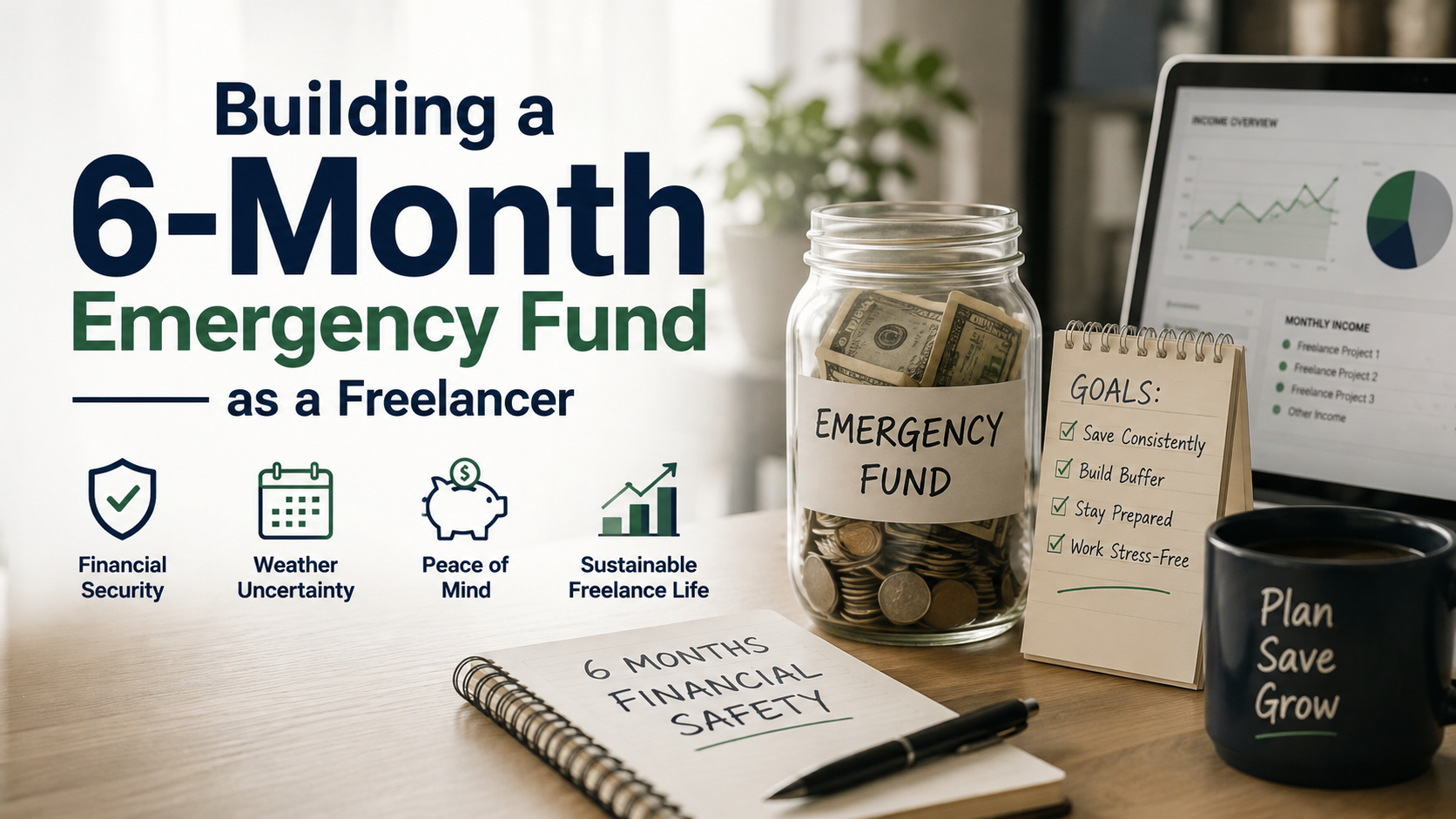
Freelancer income doesn’t arrive the way a paycheck does. One month you’re turning down work, the next month a client goes quiet and your invoices sit unpaid for weeks. That gap between “steady” and “scary” is exactly why an emergency fund matters more for a freelancer than for almost anyone else with a job. This isn’t a theoretical exercise. It’s the difference between riding out a slow quarter calmly and scrambling to cover rent with a credit card.
Why the Standard Advice Falls Short for a Freelancer
Most personal finance guides say you need three to six months of expenses saved up. That number was built around people with W-2 jobs, predictable paychecks, and severance packages if things go wrong. A freelancer doesn’t get any of that. There’s no unemployment insurance waiting in the wings if a client cancels a contract, and there’s no HR department smoothing over a slow payment cycle. One older survey on financial preparedness found that only a minority of freelancers said they could comfortably absorb an unexpected expense, which says a lot about how thin the margin usually is.
For a freelancer, a slow month isn’t a hypothetical disaster scenario, it’s a Tuesday. A client ghosts. An industry has a rough quarter and every prospect goes cold at once. A big project wraps and the next one hasn’t started yet. None of these are rare events. They’re just part of doing business without a boss.
That’s why financial writers who work with self-employed clients tend to push freelancers toward the higher end of the savings range, six months of essential expenses rather than three. If your work is project-based, seasonal, or concentrated in one industry, some advisors suggest stretching even further, closer to nine months.
A regular job has its own built-in stabilizers: sick days, a notice period before a layoff, sometimes a severance check on the way out. Strip those away and what’s left is a freelancer’s actual financial reality, income that can drop to zero with no warning and no cushion unless you built one yourself. That’s not meant to scare anyone off the freelance life. It’s meant to explain why the savings conversation looks different once you’re the one signing your own paychecks.
How Much Should a Freelancer Actually Save?
Start with your bare-bones number, not your comfortable, everything-included number. Add up rent or mortgage, utilities, groceries, insurance, minimum debt payments, and transportation. Leave out the subscriptions, the takeout, and the nice-to-haves. This is the number you’d need to survive, not thrive, if income stopped tomorrow.
Multiply that monthly figure by six. If your essential expenses come out to $2,500 a month, your target sits around $15,000. That can feel like a mountain when you’re just getting started, and that’s fine. The goal isn’t to hit it in a weekend.
One detail a lot of freelancers miss: your emergency fund is separate from your tax savings. Money you’re setting aside for quarterly estimated taxes is already spoken for. It belongs to the government, not to your rainy-day cushion. Mixing the two accounts is one of the easiest ways to think you have more of a safety net than you actually do.
Break the Target Into Smaller Wins
A six-figure-sounding goal is discouraging if you look at the whole thing at once. Break it down instead. Aim for one week of expenses first, then two weeks, then a full month. Each milestone is a real, felt improvement, and celebrating those smaller wins keeps the habit alive long after the initial motivation fades.
It also helps to separate the fund from your general savings mentally, even if the account name doesn’t say so out loud. A freelancer who lumps rainy-day money in with vacation savings or a future equipment upgrade tends to spend it on whichever goal feels most urgent that week, and an emergency fund that gets raided for a new camera lens isn’t doing its actual job anymore.
If your work leans toward one industry, it’s worth being honest with yourself about how exposed that makes you. A freelancer with three long-term retainer clients across different sectors is in a very different position than one relying on a single platform or a single niche that could shift overnight. The more concentrated your risk, the more sense it makes to lean toward nine months instead of stopping at six.
Where to Actually Keep the Money
The account matters almost as much as the amount. A freelancer’s emergency fund needs to be reachable within a day or two but not so easy to touch that it becomes a backup shopping fund.
A high-yield savings account at a different bank than your everyday checking account is the common recommendation, and for good reason. Keeping the money slightly out of arm’s reach reduces the temptation to dip into it for something that isn’t actually an emergency. Rates on easy-access savings accounts have been sitting in a reasonable range lately, so there’s no good reason to let this money sit in a checking account earning nothing.
The psychological separation matters as much as the interest rate. When the emergency fund lives at a different bank, checking the balance takes an extra step, logging into a second app, maybe entering a separate password. That small bit of friction is exactly the point. It’s enough to stop an impulsive transfer without making the money genuinely hard to reach when a real emergency actually shows up.
Avoid anything that locks the money away for a fixed term. Certificates of deposit and similar products might pay a slightly better rate, but an emergency fund that takes two weeks to access, or comes with a penalty for early withdrawal, defeats the entire purpose. This money needs to move within a day or two, no negotiating.
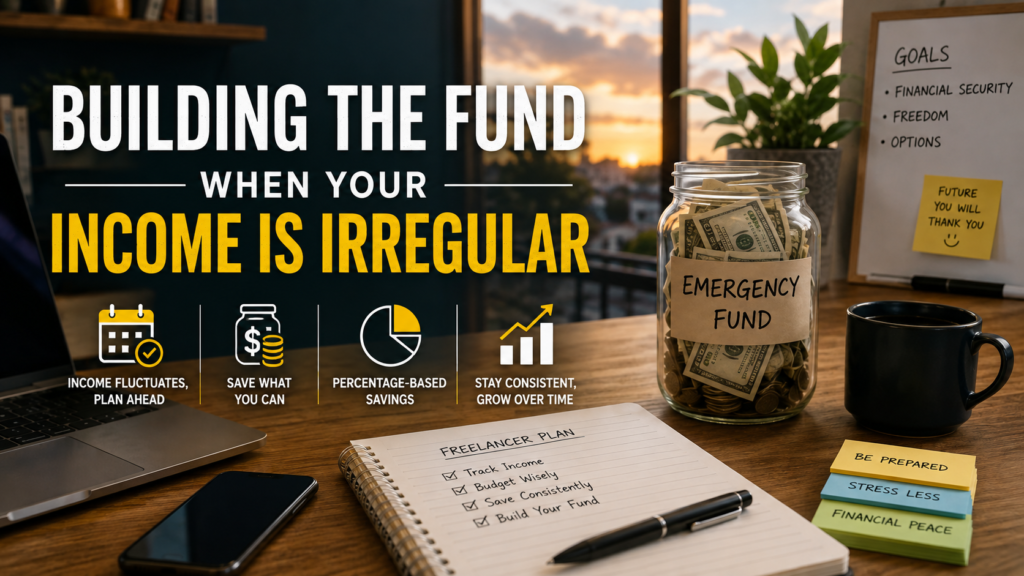
Building the Fund When Your Income Is Irregular
This is the part that trips up almost every freelancer. Budgeting off a “normal month” doesn’t work when your income swings by thousands of dollars from one month to the next. A better approach is treating every payment, not every month, as the unit you’re saving from.
The Percentage-of-Payment Method
Set aside a fixed percentage of every client payment the moment it lands, before you touch it for bills or business expenses. Ten to fifteen percent is a common starting point, though some freelancers push closer to twenty when they’re behind on their goal. If a client pays you $3,000 and you’re saving ten percent, that’s $300 that moves straight into the emergency fund before anything else gets paid.
The habit matters more than the percentage. If you get paid in chunks rather than one lump sum, automate the transfer per deposit instead of waiting until the end of the month. Waiting invites you to spend the full amount first and “catch up on savings later,” which rarely actually happens.
Any unexpected money, a bonus project, a tax refund, a gift, deserves a bigger cut than your normal rate. Some freelancers put half of any windfall straight into the fund, since it wasn’t part of the budget to begin with and won’t be missed the way regular income would be.
A zero-sum approach works well alongside the percentage method. The basic idea is living off last month’s income instead of this month’s, so every dollar earned today has already been assigned a job by the time it lands, whether that’s a bill, a business cost, or the emergency fund itself. It takes one slow month to build the habit and a few more to trust it, but once it clicks, it removes a lot of the guesswork around whether you can actually afford to save this particular week.
None of this needs to be complicated. A basic spreadsheet, or even the calculator built into most banking apps, is enough to track progress. The tools matter far less than showing up for the transfer on the same day, every time, without exceptions.
What Freelancers on Reddit Actually Say About This
Ask around in freelancer communities and the advice sounds less like a textbook and more like lived experience. In one recent discussion in the r/freelance community, freelancers compared notes on keeping a rainy-day cushion alive, not just building it once and forgetting about it. A recurring theme was treating the fund as something you maintain, not a box you check and move on from. People described automatic transfers tied to invoice payments, moving a set dollar amount the same day money hits their account rather than relying on willpower at the end of the month.
Several commenters also pointed out something worth repeating: a fund that shrinks during a slow stretch and never gets rebuilt isn’t really an emergency fund anymore, it’s just a delay tactic. The freelancers who seemed to have this figured out treated topping the fund back up as its own recurring task, the same way they’d treat paying a bill.
There was also a fair amount of disagreement in the thread, which is worth mentioning because it’s realistic. Not every freelancer agreed on the right percentage to save, and a few pushed back on the idea of a fixed six-month number, arguing that the right size depends heavily on how many active clients someone has and how quickly they could replace lost income. That disagreement is actually useful. It’s a reminder that the target isn’t a universal law, it’s a starting point you adjust based on your own risk.
What came through clearly, regardless of the exact numbers people used, was that consistency beat intensity. Nobody in that thread described building a six-month cushion in one dramatic push. It was small transfers, repeated often enough that the balance grew without anyone having to think about it too hard on a day-to-day basis.
Increasing Your Savings Rate Without Burning Out
Budgeting alone stops moving the needle eventually. Cutting expenses only gets a freelancer so far, and past a certain point there just isn’t much left to trim. The more reliable lever, especially for anyone running a service business, is increasing consistent cash flow rather than squeezing an already tight budget.
A few ways freelancers do this without taking on a pile of new clients:
- Add a retainer option. Even a small monthly check-in package smooths out income compared to one-off projects.
- Upsell existing clients. A “next phase” package for someone who already trusts your work is often an easier sell than chasing something new.
- Spread work across more than one industry. If one sector slows down, the others can carry the fund-building while that recovers.
Handling clients who pay slowly also matters more than people expect, since a single overdue invoice can undo weeks of careful saving. If that’s a recurring headache, it’s worth reading through a separate guide on dealing with late-paying clients without burning the relationship down.
Common Mistakes That Slow a Freelancer Down
Treating the fund as flexible spending money. The point of the account is to sit there, boring and untouched, until an actual emergency shows up. A new laptop is a business expense, not an emergency.
Forgetting the fund exists once it’s “big enough.” Life doesn’t wait for a convenient time to hand a freelancer an emergency. Keep the automatic transfers running even after hitting the target, just at a lower rate, so the fund keeps pace with rising expenses.
Ignoring taxes when calculating the target. A freelancer who forgets to add a quarter’s worth of estimated tax payments to their real target ends up short exactly when it matters most.
Not planning past the emergency fund. Once the safety net is solid, a freelancer’s next step is usually thinking longer term. Since there’s no employer-sponsored 401(k) waiting in the background, it’s worth looking into retirement options built for self-employed income once the six-month cushion is in place.
Chasing a bigger number before locking in the habit. It’s tempting to fixate on reaching the full six months as fast as possible, sometimes by taking on too much work at once and burning out before the fund is even halfway built. A slower, steadier pace that a freelancer can actually sustain beats a sprint that stalls out after two months.
Keeping the fund somewhere too convenient. A savings account sitting right next to your checking account, visible every time you open the banking app, invites small withdrawals that add up. Out of sight tends to mean the money actually stays put.
Final Thoughts
None of this requires a dramatic overhaul of how a freelancer runs their business. It requires a boring, repeatable habit: a percentage of every payment, moved automatically, into an account that’s hard to touch and easy to forget about until the day it’s needed. The freelancers who manage to sleep through a slow month usually aren’t the ones earning the most. They’re the ones who built the cushion before they needed it.
Start small if you have to. One week of expenses is still real progress, and it’s a lot closer to six months than doing nothing at all.
There will be months where saving anything feels impossible, and that’s normal for anyone running an income that isn’t guaranteed. The point isn’t perfection. It’s having something set aside the next time a client disappears, a project falls through, or an entire quarter turns out slower than expected. A freelancer who plans for that ahead of time gets to treat it as an inconvenience instead of a crisis, and that difference alone is worth every automatic transfer it took to get there.
